Matching Wits in Jerusalem: Talmud and St. Paul
BY THOMAS L. FRIEDMAN, Special to the New York Times.
JERUSALEM, Jan.26...From a distance the scene looks like any medieval yeshiva: young boys huddled in small groups, their yarmulkas slightly askew, gesticulating wildly over thick Babylonian Talmuds that lie before them.
But a closer look reveals a priest's collar among the yarmulkas. Elbow-to-elbow with the yeshiva boys pounding tables for emphasis is a nun. Nestled amid the Talmuds is the Gospel According to John.
What lies behind this ecumenical collage is an unusual experiment in Jewish-Christian understanding. It is an attempt by Jewish and Christian theologians to get at the roots of Christian anti-Semitism, as well as to open up Jewish thinking to the validity of other religious cultures. To do this they are studying together the scriptures of each religion and trying to re-examine the foundations of each faith's understanding of the other.
The month-long seminar is being sponsored by the New York-based National Conference of Christians and Jews in conjunction with the Shalom Hartman Institute for Advanced Jewish Studies, a research and learning center here.
GRASPING THE NETTLES
The purpose of the seminar--which has brought together 26 American and European Christian Bible Scholars, led by Paul M. Van Buren of Temple University, and young Talmudists from the Hartman Institute--is that much of the Jewish-Christian discussion of the past has really avoided the gut issues dividing the two religious communities.
Previous Jewish-Christian encounters, participants in the seminar say, have traditionally been either debates between theologians, mutual scolding sessions or syrupy social get-togethers in which both sides affirm the principle of live-and-let-live and everyone goes home "friends."
"Every encounter that took place before was either to prove who was right, who had the real Truth, or was a get-together over tea on a 'some of my best friends are...' basis," said Ellen Charry, associate program director of the National Conference of Christians and Jews.
"That is not what we are doing here. We are trying to bring each side to the edge of a sympathetic understanding of the other. The old dialogue put the texts aside. We want to put on the table the reality of those texts that create obstacles to good fellowship and ask, 'What can we do with these documents?'"
What makes the current encounter so powerful, and at times explosive, is that people's real identities as Christians and Jews are at stake, Professor Van Buren said.
"People are having their own understanding of their tradition challenged, and that is a very powerful business," he added. "We are getting into each other's workshops."
The conference is organized in small study groups, each containing five to six Christian theologians and one Talmudist. Each group studies Talmud and reads texts from three different periods: the early Rabbinic period (such as Philo and the literature of the Qumran community), New Testament literature, and finally the Patristic literature (the early Catholic Church interpretations of the New testament).
Each group reads the individual texts and tries to see how the different generations interpreted the earlier sacred literature, what strategies and range of imagination they used. The groups regularly prepare reports on the their findings to the whole seminar, setting off wide-ranging discussions.
NO ILLUSIONS
None of the participants seem to have any illusions that they will come up with clear-cut answers to the fundamental questions they are asking each other, namely: Is it possible to be a believing Christian or Jew without seeing the other as illegitimate to a certain extent?
If the texts are reviewed in light of the situation of today, will the roots for a new kind of pluralism be there or must they always lead to "I have the only truth?" What to do with problem texts--that is, texts that point up real divisions between Christians and Jews? Can they be reinterpreted in the context of today? Can they be isolated, or is there no escaping them?
For example, one of the groups was reading the epistle of Paul to the Galatians, in which Paul speaks about the promise God gave to Abraham and the Covenant He made with the Jewish people. "We ask ourselves how can Paul say that the law is fulfilled in Christ," said the Rev. George C. Papademetriou, a Greek Orthodox theologian from Hellenic College near Boston. "What happened with the Covenant God made with Abraham and Israel? Is this carried on? Some say that Paul was not trying to abrogate the Covenant. Others say that he was and that we might as well admit that and deal with the text differently."
AN EXERCISE IN RESPECT
Theological questions aside, just the pure encounter of learned Jewish and Christian scholars interpreting texts together has been an exercise in mutual respect.
"Yesterday I was trying to spell out a distinction in the Talmudic passage we were working on, and I got it right," said Ellen Lewin, an Episcopalian doctoral student in Old Testament studies at Yale. "My teacher, one of the men from the Hartman Institute, looked at me quite hard and somewhat surprised and said: 'You know, you would make quite a good Talmudist.' I always had a feeling I would be good at it."
"It is the first time that I have ever learned with a religious person from the Christian religion," said Uri Ehrlich, a 28 year-old Talmudist. "I have met some Christians here and there, but never one who was as religious as me. The whole experience is such a contrast to what I had in my mind of Jews cursing the Christians in their texts and the Christians persecuting the Jews. Also, now we as Jews can also argue with Christians in a situation in which we have the political power. It makes a difference."
Indeed, it is no accident that such an experiment in rethinking between Christians and Jews would happen for the first time in Jerusalem, said the Jewish philosopher David Hartman, founder of the institute and the man whose personal discussions with Professor Van Buren provided the original spark for the seminar.
"In Jerusalem, Christians can't deal with Jews as just an Old Testament people," noted Mr. Hartman. "They have to face the living reality here, the fact that they are a living people, not just an instrument in the development of Christianity, not just a wandering nation. And for the Jews, this is the best place to start rethinking some of their negative attitudes about Christianity--in their own country where they don't have to feel insecure."
None of the participants seem quite sure of what exactly will constitute a success for the seminar. Most, it seems, will be pleased if they can at least clarify the problems and agree that it is not a futile exercise to try to build a framework for a new kind of tolerance--a tolerance that just wont mean not beating up on each other but also being able to celebrate each other's differences.
"In the old method of Jewish-Christian dialogue," said Rabbi Tzvi Marx, the education director of the Hartman Institute, "one side always won and one side always lost. In our method everyone goes home confused."
Christian Fulfillment and Jewish-Christian Dialogue
Isaac C. Rottenberg
LIVELY DEBATES are taking place among Christian theologians in dialogue with Jews. Christians are seeking to discover what aspects of their faith are or are not negotiable as churches reassess their position vis-à-vis Jews and Judaism.
Quite understandably, the Christian belief in Christ as the world's redeemer is at the center of Christian-Jewish dialogue. Or to put the issue more in terms of the Jewish dialogue partner: If redemption has occurred in Christ, why is the world so obviously unredeemed? This question has profound implications for other issues such as attitudes toward mission and even approaches to social-political matters.
Eugene Fisher's article "Covenant Theology and Jewish-Christian Dialogue" in the January-May 1998 issue of the American Journal of Theology and Philosophy may be taken as representative of the Christian attempt to establish common ground for Christian-Jewish dialogue. He writes: "While earlier generations of Christian thinkers tended to stress only the 'already here' aspects of New testament kerygma, more recent scholarship has sought to reintegrate the eschatological 'not yet' into their vision. In other words, we ought not to make claims for redemption today as if the kingdom of God had already arrived, and we should not spiritualize redemption in such a way that we remove it from history. Fisher reminds us that the promises of the messianic age have not been fulfilled. Whatever Christians may believe about Jesus as messiah, both Jews and Christians are still waiting for the fulfillment of redemption.
By emphasizing the proleptic or anticipatory nature of Christ's redemptive work, and by saying that Jesus is messiah in a not fully accomplished way, we can retrieve for systematic theology the "not yet" aspect of messianic ministry and also meet some of the Jewish objections to certain historic Christian claims...We may add a quote from John T. Pawlikowski: "All talk of a realized eschatology must be buried once and for all. What we Christians in our faith now profess is that through the coming of Christ we have a clearer vision of the final dimension of the kingdom."
Fisher also contends that the term fulfillment should be "reserved for its proper eschatological usage, that is to the End Time when the Kingdom will be made manifest and the One God, the God of Israel, will be all in all."...
The idea of fulfillment is used both in a christological and pneumatological context in that what God is doing through the Spirit is considered so dramatic and so monumental that the New testament writers constantly take recourse to the language of "pleroma." The concept refers to time, Torah, prophecy, individuals, the church, even the cosmos.
For example, the stories in Acts 1-2 describe the ascension and the outpouring of the Holy Spirit on all flesh, and Ephesians 4:9 explains that Christ "ascended far above all heavens that he might fill all things." The New testament tells us that the incarnation has come to an end, but the presence of the historically acting God has not.
We cannot get away from the fact that in the New testament we are confronted with statements about redemptive "fait accomplis" that are both numerous and extraordinary. In Christ "all the fulness (pleroma) of God was pleased to dwell, and through him to reconcile to Himself all things, whether on earth or in heaven, making peace by the blood of his cross." (Colossians 1:19). Something has happened. The historically acting God has intervened mightily in the affairs of humankind. At the same time, we are constantly reminded that as those who have tasted "the powers of the age to come" (Hebrews 6:5), we are...(still awaiting) "a salvation ready to be revealed in the last time." (1 Peter 1:5)...
To talk about the End Time as messianic time seems unnecessarily confusing...and counter to 1 Corinthians 15:24-28. It suggests that in the end the Son will deliver the kingdom of the Father...During the interim between the ascension and the perousia, says the text, Christ must reign, and he does so during an era when the forces of sin and death are still very much operative in the world...
Just as theologians have said that the revealed God remains the hidden God, so we can say that the power of the age to come in our midst means that signs of the kingdom, very real signs, are revealed to us while at the same time the kingdom remains hidden and is yet to be revealed in all its glory. In that sense the world remains unredeemed. The New Testament makes it very clear that there are still hostile forces to overcome. "And the last enemy to be destroyed is death." (1 Cor.15:26).
The New Testament message gives many reasons for joy, but none for Christian triumphalism. The kingdom of God has not arrived, nor have we Christians arrived. However, we are not left empty-handed either. As we read in 1 Corinthians 4:20, "The kingdom of God does not consist in talk but in power." Romans 14:17 expands on this theme by stating that "the Kingdom of God...(means) righteousness and peace and joy in the Holy Spirit."...
Judaism also lives by a magnificent vision of the future of the Lord. Both faiths represent a journey of hope. Where we clearly differ is in our understanding of the meaning of redemption in light of Jesus' life and ministry... What does this mean for dialogue. To answer that in a personal way, I accept the fact that my Jewish friends don't believe a word of some of the things I have affirmed...On the other hand I realize that mature dialogue requires one to stand some heat, to recognize the profound faith perspectives that may lie behind other people's rejection of one's position. This encounter can lead, in turn, to a deepened respect for the faith and practices that enrich the dialogue partner's life. It is to understand the pain of our dialogue partners, and to face more honestly some of the terrible things that have been done in the name of our own tradition.
I do not believe that the kind of fulfillment theology I have briefly outlined will "ipso facto" lead to Christian triumphalism. Whatever New testament "plerophoric" language may mean, it most certainly does not refer to a fulness in our (present) theological wisdom." The Christian Century, April 12. 1989.
THE AUTHORS OF THE GOSPELS
"Mention of the Essene hopes of a New Age of glory leads us naturally to some comments on the special theological views of the Essenes that informed their understanding of history and gave to their community its peculiar institutions. The Essenes belong in the center of that movement (known as) apocalypticism. The late visionaries of the Old Testament, notably the author of Daniel, as well as the later Baptist and Christian communities, discovered themselves to be living in the last days of the Old Age, or rather in the days when the Old Age was passing away and the Kingdom of God was dawning. According to apocalypticism, the upsurge of evil powers in the world reflected the last defiant outbreak of cosmic Satanic powers. The gifts of the Holy Spirit manifest in the community of the faithful, adumbrated the age of the Spirit to follow the final war in which the Spirit of Truth and his heavenly armies would put an end to the rule of the powers of Darkness. The constitution of the Essene community was a crystallized apocalyptic vision. Each institution and practise of the community was a preparation for or, by anticipation, a realization of, life in the New Age of God's rule. ON THE ONE HAND, THEIR COMMUNAL LIFE WAS A REENACTMENT OF THE EVENTS OF THE END TIMES, both the final days of the Old Age AND the era of Armegeddon. (An understanding that is wholly, yet cryptically reflected in the Gospel narratives). On the other hand, their community, being heirs of the kingdom, participated already in the gifts and glories that were the first fruits of the Age to come. For the apocalypticists of Qumran the key to these future mysteries was At Hand. One had only to read biblical prophecies with the understanding given the inspired interpreter (that is, one who reads with the power of the Holy Spirit) because the secrets of events to come in the last days were foretold by God through the mouth of the holy prophets…
In apocalyptic exegesis, three principles should be kept in mind. Prophecy openly or cryptically refers to the last days. Second, the so-called last days are in fact (in types and figures) the present, the days of the sect's life. And finally, the history of ancient Israel's redemption, her offices and institutions, are prototypes of the events and figures of the New Israel.
On this basis, the Essene camp in the wilderness found its prototype in the Mosaic camp of Numbers (Numbers 2 to 4; 9:15-10:28). The Essenes retired to Qumran to 'prepare the way of the Lord' in the wilderness. As God established His ancient covenant in the desert, so the Essenes entered into a New Covenant on their return to the desert. As Israel in the desert was mustered into army ranks in preparation for the Holy War of Conquest, so the Essenes marshaled their community in battle array and wrote liturgies of the Holy Warfare of Armageddon." Understanding the Dead Sea Scriptures by Hershel Shanks, pp.26,27.
(The Essene) Yacob...to the Twelve Tribes scattered abroad, greeting....(James 1:1)
Behold, I send an Angel before thee...(Exodus 23:20-23; Malachi, chapter 4).
And they saw the God of Israel (the Metatron); and there was under his Feet as it were a paved work of sapphire (sefirot), AND AS IT WERE THE BODY OF HEAVEN IN HIS CLEARNESS...(Exodus 24:10; 1 Cor.15:1-8).
Till we all come in the Unity of the faith, and of the knowledge of the Son of God, unto a Perfect Man, unto the measure of the stature of the Fulness of Christ...(Ephesians 4:13).
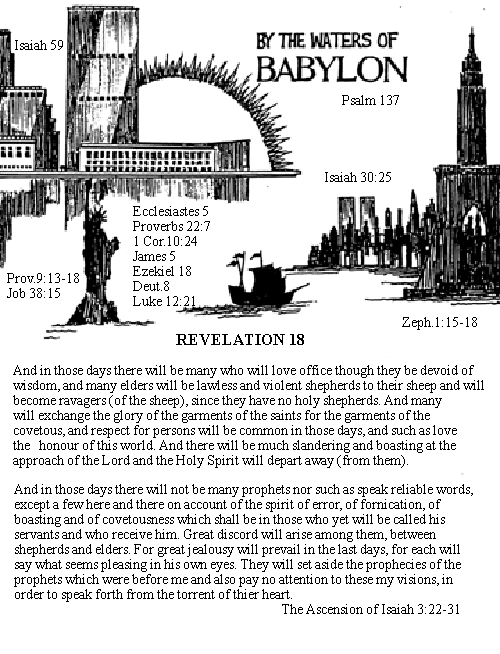
(Visualize the three main Hasidic communities of Brooklyn): These men were bound in their coats, their hosen, and their hats, and their other garments, and were cast into the midst of the burning fiery furnace...
And he answered and said, Lo, I see Four men loose, walking in the midst of the fire, and they have no hurt; and the form of the Fourth is like the Son of God...(Daniel 3:21-25; 1 Peter 4:12).
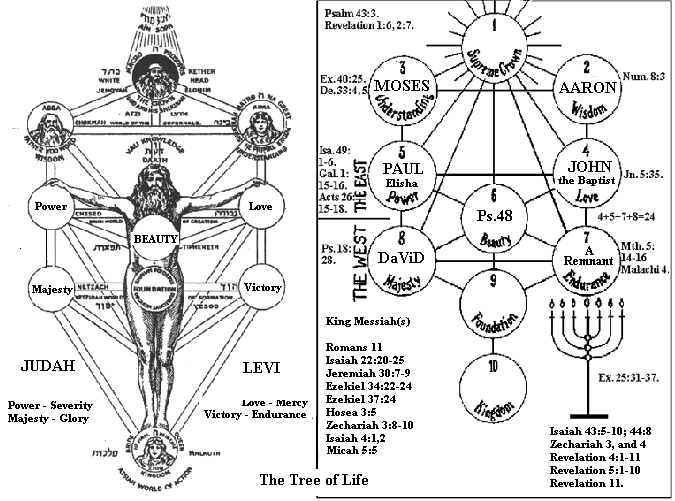
One side of the Tree (the Solar side as it is) is Christianity, the other side of the Tree (the Lunar side) is Talmudic Judaism. This is why we are commanded to blow the Trumpet in the New Moon. The Messiahs of DaViD shall appear from this side of the Tree in our very own time. (Isaiah 4:1,2; Isa.30:26). Christianity's Paul, and Judaism's Elisha ben Abuyah, are one and the same. Christianity's John, the son of Zechariah (he who appeared among the Essenes of his time), and Judaism's Yochannan ben Zakkai, are (originally) one and the same. (They were one and the same before the name itself was carried cryptically over to the Jewish side of the Tree, before all of the redactions of those times--the readoption and rearranging of names and ideas to suit rabbinic sensibilities. The rearrangements took place, over time, not only to satisfy the severe conflicts the rabbis were having with the doctrines of their coreligionist and fellow Pharisee, Paul, and with those Essenes who seem to have been in league with him, and who seem to have also taken the Torah beyond its appointed bounds, but because the ideas themselves were being sealed up, from both Judaism and Christianity together). The names, along with all of the Merkabah mysteries and Gnostic doctrines of the Essenes, were carried over and planted in the Jewish mind by Simeon bar Yonah whose ministry was directly to the Circumcision. (Galatians 2:6-9). Christianity's Simon (Peter), and Judaism's Simeon b. Jochai are (originally) one and the same. (They were one and the same until years later when the scripts were reworked and the teachings were put in the mouth of another, a disciple of Rabbi Akiba it is said, who passed on the doctrines in the name of the original Simeon, or Schimeon. Talmudic writings also, and quite fittingly, find Simeon b. Yochai in Rome teaching at the academy, or court, of Rabbi Mathia b. Heresh):
"Rabbi Schimeon (Simon) sat down and wept; then he said, 'Woe! if I should reveal it! Woe! if I should reveal it not.'
His companions who were with him were silent.
Rabbi Abba arose and said unto him: 'With the favour of the Lord, also it is written, (Ps.24:14), "The Arcanum of Tetragrammaton (YHVH) is with them that fear him." And well do these companions fear the Holy and Blessed One; and now they have entered into the assembly of the tabernacle of his house, some of them have only entered, and some of them have departed also.'
Moreover it is said the companions who were with Rabbi Schimeon were numbered and they were found to consist of Rabbi Eleazar, his son; and Rabbi Abba, and Rabbi Yahuda, and Rabbi Yosi the son of Jacob, and Rabbi Isaac, and Rabbi Chisqiah the son of Rav, and Rabbi Chia, and Rabbi Yosi, and Rabbi Yisa. (Ten in all).
They gave their hands unto Rabbi Schimeon, and raised their fingers on high, and entered into a field under the trees (as Druids do) and sat down...
Rabbi Schimeon began, and said, 'Time for Thee, O Tetragrammaton, to lay Thine Hand.' (see Chapter 6). Why is it time for the Tetragrammaton to lay His hand? Because they have perverted Thy law. What is this, 'they have perverted Thy law?' The Higher law, which is itself made void, if it is not carried out according to His commands. Wherefore is this? (Or, as others read: Wherefore is this name Tetragrammaton here employed?) This hath been said concerning the Ancient of Days. For it is written, Deut.33:29: 'Blessed art thou O Israel: who is like unto thee?' Also it is written, Exodus 15:11: Who is like unto Thee among the gods, O Tetragrammaton?'
He called Rabbi Eleazar his son, and commanded him to sit down before him, and Rabbi Abba on the other side, and said, 'We are the type of all things (that is, we represent the Three Columns of the Sephiroth); thus far are the columns established.' (Compare Galatians 2:9).
They kept silence, and they heard a voice; and their knees knocked one against the other with fear. What was this voice? The voice of the Higher Assembly, which has assembled above. (For out of Paradise came the souls of the just thither, that they might hearken, together with the Shekinah of the Divine Presence).
Rabbi Schimeon rejoiced, and said, 'O Tetragrammaton! I have heard Thy speech, and was afraid!' (Hab.3:1). He hath said: It is rightly done, seeing that fear hath followed; but for us the matter dependeth upon love. (Understand 1 John 4:7-21). Like as it is written, Deut 6:5: 'And thou shalt delight in Tetragrammaton thy God,' also it is written, Malachi 1:2, 'I have loved you.'
Rabbi Schimeon said further: 'He who walketh, going up and down (from one house to another) revealeth the secret; but the faithful in spirit concealeth the word.' (Prov.11:13).
But concerning him who is firm in spirit it is written: 'But the faithful in spirit concealeth the word.' (This phrase) 'faithful in spirit' denoteth firmness of spirit, like it is said, Isaiah 22:23: 'And I will fasten him as a nail in a sure place.' Matter dependeth upon spirit...
For neither doth the world remain firm, except through secrecy. And if in worldly affairs there be so great a need for secrecy., how much more in the things of the most Secret of secrets, and in the meditation of the Ancient of Days, which matters are not even revealed to the highest of angels?
Rabbi Schimeon said, moreover: 'I will not say unto the heavens, that they may hear; I will not declare it unto the earth, that it may hear; for certainly we are (the symbols) of the pillars of the Universe.'
It is said in the Arcanum of Arcana, that when Rabbi Schimeon opened his mouth, the whole place was shaken, and his companions were also shaken. (see Hebrews 12:25-29). The Kabbalah Unveiled, The Greater Holy Assembly, by S.L. MacGregor Mathers, pp.109-111.
Just what was Rabbi Schimeon concealing? The higher mysteries, the whereabouts of the City Above, Middle Earth (Psalm 74:12-14), and the unfolding of Divine Reality--the very same that are hidden in the writings of Paul, and in all the subsequent gospels and various Acts of the Apostles and tractates of the early Church, indeed, the very same that are unfolding in the world as we speak. (And please do not confuse early Christianity with the Papal and other orthodox institutions that emerged in the name of Christ centuries later. Acts 20:25-35. These had no more of a sense of it than, well than the rabbis did. It was hidden from everyone. Isaiah 29:10, 11; Revelation 5:1). Take all that we understand, and all that has been written on the subject of the Dead Sea Scrolls, and all that Gershom Scholem and others have written on the subject of Kabbalah. Take all of the Gnostic texts that have come down to us, and all of the Pseudepigraphical literature at our disposal. (One might also make good use of such works as Erwin R. Goodenough's Jewish Symbols in the Greco-Roman Period, and G.R.S. Mead's Did Jeus Live 100 B.C.? An Inquiry Into the Talmud). Take all of these things together, and lay them out from one end of the age to the other--from East to West. Lift up our minds to the higher transcendent dimensions of reality, believing all things, admitting every doctrinal error, and every prior inability to understand and interpret the Truth of things, and we will immediately reacquire the ability to interpret the whole of it in its true Light.
And Elijah (the spirit of John the Baptist) took Twelve Stones, according to the number of the sons of Jacob, unto whom the word of the Lord came, saying, Israel shall be thy name...(1 Kings 18:31).
And when the sons of the prophets...saw him, they said, The spirit of Elijah doth rest on Elisha. And they came to meet him, and bowed themselves to the ground before him...(2 Kings 2:15).
But I tell you of a truth. many widows were in Israel in the days of Elias (Elijah), when the heavens were shut up three years and six months...but to none of them was Elias sent, save to Sarepta, a city of Sidon, unto a woman that was a widow.
And many lepers were in Israel in the time of Eliseus (Elisha) the prophet, and none of them were cleansed, saving Namaan the Syrian...and they, when they heard these things, were full of wrath...(Luke 4:25-28).
And please do not insist that Paul's Christ, the Nazarine of the Gospels, the illusive Jesus of myth and legend (the Universal Suffering Servant; The High Priest, Melchizedek; Hesus of the Druids; the Son of Brahma, Crishna of the Vedas; the Jehoshua of the Torah; the Divine Monarch, Son of David [Psalm 48]; Horus, the Sun of Righteousness; The God of War; the Wodin and Thor of the great North; The Angel of Divine Presence, the Metatron), be a single individual who ever lived at one single time in history, or in one single human figure alone. But rather see this manifestation of the Godhead present in all things, in every age, in every living being, in every human story, and in every unfolding historical event, as well as in every precept of the Torah. Then, following the pathways of the Oracle from the time of Moses, realize that if one cannot see the Christ-spirit revealing itself, not only to, but in the life of this single individual called Paul, while hiding itself from all the sons of Darkness who came after him, they shall understand nothing of the birth and meaning of Christianity. While the others in this Fellowship came up into the Center of the Mystery under the name of YHShWH (the Angel of Divine Presence appearing in the name of Jehoshua), the Apostle Paul (Elisha ben Abuyah) is the author (or rather the reviver) of the doctrine of Christ and him crucified. The doctrine is older than Christianity itself.
Elisha ben Abuyah...entered the Pards (2 Corinthians, chapter 12) and became a heretic. Known as "Aher," "that other one," he saw the Metatron and said, "There are two."
Isaac M. Wise, in his "Rise of Christianity," says: "Then we have the Talmud with its numerous anecdotes about "Acher," as the rabbis called Paul. These sources are of inestimable value to the historian. Paul is not a proper name, it signifies "the little one," (Amos 7:5-7; Zech.4:10). The author of Acts states that his name was Saul, but it appears he knew no more about it than we do. (As Saul before David, so Paul before the Messiahs)...Passing under an assumed name the rabbis called him Acher, "Another, one who passes under another or assumed name."
They maintain that his name was Elisha Ben Abuyah, but this name must be fictitious, because it is a direct and express reference to Paul's theology. It signifies "the Saving Deity, Son of the Father God," and Paul was the author of the Son of God doctrine. The fact is he was known to the world under his assumed name only.
As deceivers and yet true, as unknown and yet well known...(2 Corinthians 6:3-10).
"The angel Metatron was accorded a special position in esoteric doctrine from the tannaitic period on. The angelology of apocalyptic literature mentions a group of angels wwho behold the face of their king and are called 'Princes of the Countenance" (Ethiopic Book of Enoch, ch 40, et al.). Once Metatron's personality takes a more definite form in the literature, he is referred to simply as 'the Prince of the Countenance.'
In the Babylonian Talmud Metatron is mentioned in three places only (Hag.15a; Sanh.38b; and Av.Zar.3b). The first two references are important because of their connection with the polemics conducted against heretics. In Haggigah it is said that the tanna Elisha b. Abuyah saw Metatron seated and said, 'perhaps there are two powers,' as though indicating Metatron himself as a second deity. The Talmud explains that Metatron was given permission to be seated only because he was the heavenly scribe recording the good deeds of Israel. Apart from this, the Talmud states, it was proved to Elisha that Metatron could not be a second deity by the fact that Metatron received 60 strokes with fiery rods to demonstrate that Metatron was not a god, but an angel, and could be punished. This image recurs frequently in different contexts in Gnostic literature and is associated with various figures of the heavenly realm. It is thought however that the appearance of Metatron to Elisha b. Avuyah led him to a belief in dualism." Kabbalah, by Gershom Scholem, p.377.
The rabbis had to reject Paul's doctrine, not only because he seemed to be introducing the worship of another god (the Crucified Hesus of the European Druids...Acts 17:18), rather than another manifestation of the Mystery of the One God which they could not grasp in light of their own religious, nationalistic and political circumstances--but on the very basis of the words of the Torah themselves:
And if a man have committed a sin worthy of death, and he be put to death, and thou hang him on a Tree:
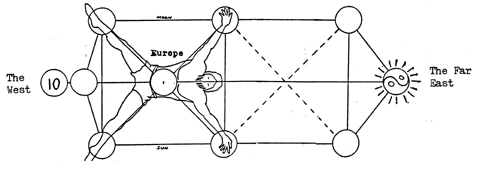
His Body shall not remain all night upon the Tree, but thou shalt in any wise bury him that day; (for he that hanged is accursed of God); that the land be not defiled, which the Lord thy God giveth thee for an inheritance...(Deuteronomy 21:22,23).
This, however, is exactly what the Christ-mystery came into the earth to accomplish, to bear upon its cosmic limbs both the good and the evil among men, to serve as the ultimate means of human transformation, and to make an atonement at last for the sins, not only of Israel but of the whole world...indeed, to make an atonement as well on behalf of God. The Remnant on the lefthand (Solar) side of the Tree of Life shall make the atonement and offer the Evening Sacrifice:
For the preaching of the Cross is unto them that perish foolishness, but unto those who are saved it is the Power of God...
For the Jews require a sign, and the Greeks seek after wisdom.
But we preach Christ crucified, unto the Jews a stumbling block, and unto the Greeks foolishness.
But unto them which are called, both Jews and Greeks, Christ the Power of God, and the Wisdom of God....(1 Corinthians 1:18-24).
__________
Behold, he cometh with clouds (Hebrews. chapter 12), and every eye shall see him, and they also which pierced him: and all kindreds of the earth, shall wail because of him. Even so, Amen.
I am Alpha and Omega, the beginning and the ending, saith the Lord, which is, and which was, and which is to come, the Almighty...
I am he that liveth, and was dead; and behold, I am alive for evermore, Amen; and have the keys of hell and of death...(Revelation 1:7,8, 18).
Thus closer to our own time, if one can not look back and see the Angel of Presence descending in Fire, in the midst of the world wars of the 20th century (Ezekiel 5 to 9 for instance), they will see Him nowhere else. (Open the pages of the Book of Jeremiah at the turn of the 19th and 20th centuries). And if one could not see the Divine Angel flying into the World Trade Center on September 11, 2001, they will see Him nowhere else...
Then the earth shook and trembled; the foundations also of the hills moved and were shaken, because he was wroth.
There went up a smoke out of his nostrils, and fire out of his mouth devoured: coals were kindled by it.
He bowed the heavens also, and came down: and darkness was under his Feet.
He rode upon a cherub, and did fly: yea, he did fly upon the wings of the wind (the divine Kami Kazi)...(Psalm 18:1-10).
And if one cannot see the Holy One risen up at this present moment in time, in all of the powers of the Earth, bringing both America and the Zionist state to their impending judgments; and if one cannot understand how, at the same time, this very same Presence is also about to reveal Him and Herself in the Anointed Ones of DaViD (Hebrews 2:1-11), they will understand nothing of the Divine Drama that is unfolding in the world. Christianity itself is about to come to its own conclusion, to the fulfillment of its mission, as the Sun sets on the terrible events of this age and as the Child of Revelation is born. This Child is an emerging state of Higher Spiritual Consciousness. It is a new Nation, one that is about to be born out of the Darkness of this age into the Light of the age-to-come. (Deuteronomy 4; Isaiah 66). And those, whether they be Christian, Jew or Muslim, who insist upon a literal, historic rendering of the Gospels (or the Torah, or the Qur'an), as opposed to a mystical, epic and suprahistorical interpretation of these documents, shall continue to stumble over the Rock that followed them (or in the case of those who have gone backwards, away from the course of this great Mystery: over the Rock that passed over them, and proceeded them to the ends of the earth, and the fulness of time...1 Corinthians 10:1-12). Many Jews, of course, will, ironically, insist on a literal person (rather than a mystical Fellowship) who came in the name of Jesus, so that they can continue to concentrate, and maintain their historic animosity toward Christianity itself. Nothing, it seems, is ever attributed to the Wisdom of God.
We have included excerpts from the following two tractates; not only in the hope that both will accept the criticism, but to dispel the errors that have been built into the world-views of both Jews and Christians--by Jews and Christians themselves. Both (if they will accept the charge) are responsible for the animosities between them, and both are responsible, because of their mutual failure to keep God's Sabbaths (the true meanings of God's holy statutes as they were revealed to the world over the course of the last two thousand years), for the judgments that are now visiting the earth, and which have been unfolding in the world since the morning of the 20th century. Both are in Darkness, and both are in violation of God's Holy Torah, (many, of course, moreso than others; there is a Remnant on both sides of the Oracle).
A Torah View of the Founder of Christianity
A look at Yeshu ha Notzri, the man, (the one whom the Christians believe to be their messiah) in his own words and actions.
A review of Yeshu, taken from the Christian Bible and viewed in light of the true holy Word of G-d as He, Himself, blessed be He, revealed in His Torah.
(Originally published in Panu Derekh #16,17 by Ariel Bar Tzadok )
INTRODUCTION.
This article is a part of a larger work entitled The Gentile and the Torah--The Great Untold Story. This work was written to explain in detail the seven universal laws of spirituality (sheva mitzvot d'benei Noah). Since the beginning of Christendom, conversion of the Jews has always been a top priority for Christians. They have been taught all their lives how Jews and Judaism are wrong and that we are "blind" to seeing the so-called truth of their religion. For this great offense on our parts, the Church teaches that Jews and especially Rabbis will burn in hell for eternity. These nonsensical beliefs must come to an end
(Of course we agree)....
For I would not, brethren, that ye should be ignorant of this mystery, lest ye should be wise in your own conceits; that blindness in part is happened to Israel, until the fulness of the Gentiles be come in.
And so ALL Israel shall be saved: as it is written, There shall come out of Zion the Deliverer (and a Messiah from among the Jews), and shall turn away ungodliness from Jacob.
For this is my covenant unto them, when I shall take away their sins.
As concerning the gospel, they are enemies for your sake, but as touching the election they are beloved for the Father's sake...(Romans 11:25-28).
(And of those rabbis who lived in the time of Christ, who were appointed to set a fence around the Torah, it says): No man also having drunk old wine straightaway desireth new, for he saith the old is better...(Luke 5:39).
For centuries holy Jewish Sages have stood up against the attacks of Christian missionaries and suffered the consequences for each time proving the Church wrong in disputation after disputation. Today, Christian missionaries take advantage of the loss of Torah identity among the majority of Jews and have succeeded in converting over the last 20 years possibly more Jews than they have over the past 20 centuries. Needless to say, this is quite alarming.
Time is short and I believe it is necessary to follow in the footsteps of our holy Sages and go on the offense against the false teachings of Christianity. There are millions of sincere G-d loving, G-d fearing Christians in the world today (how could this be if their religion is false)? who pray daily on behalf of the Jewish people AND THE STATE OF ISRAEL. (Ah, the State of Israel. It was the trouble then, it is the trouble now). Indeed, in matters of morality AND POLITICS we are very similar. It is to these Christians that I address these words. They ask ever so sincerely, why we Jews don't see the so-called truth of their faith. Maybe this work will help explain to them things that we see about Yeshu that they are blind to. In no way do I wish this work to offend anybody. Unfortunately, I know that it will.
The historical Yeshu was not a good person and in no way could have been a messiah. I do not wish only to make a proclamation. I will endeavor to prove it. I will use the Christian Bible as a source, for although we Jews do not accept its accuracy or legitimacy, our Christian neighbors do accept it. May they see Yeshu with our eyes and instead of trying to convert Jews to Christianity, maybe they will assist us in bringing wayward Jews, who have converted back to Torah and mitzvot. This is my deepest wish. I offer this work in a spirit of friendship and brotherhood. May the holy light of G-d's true word, the Torah, shine in the minds and hearts of us all. (Amen).
A TORAH VIEW OF THE FOUNDER OF CHRISTIANITY
What is a Messiah supposed to be like? What should his characteristics be? (Of course, R. Akiba thought that Bar Kochba had all of these characteristics. So what does this say about the Jewish idea of messiah. But let us get past all these things)? Shouldn't he show the greatest of love, caring and forgiveness to fallen souls? Is the Messiah to be a racist? An antiSemite? A blasphemer? Can the Messiah possibly be a man of violence and a terrorist?
(So let us all agree, the Messiah must not be a racist. He (or they) must not favor his race over any other. And he must not oppose the doctrines of Semitism, in any of their forms, whether they be Jewish, Christian or Muslim--all of whom are the children of Abraham, all of whom trace their beliefs back to Shem, and to the teachings that preceded Judaism, Christianity and Islam together. Neither may the Messiah be a politician, or a Zionist...Opposition to the State of Israel is not anti-Semitism).
According to the Jewish Bible and summarized in all later Jewish holy literature, the character of the Messiah is impeccable. He is to be a man who fulfills the commandments of Torah completely. He is to restore Torah observance to Israel. Let us review Yeshu's own words as to how he interacted with the Divinely ordained Rabbinic authorities of his day.
(We must, first of all, make sure that we understand the very sublime and hidden relationship that Paul--Elisha ben Abuyah--had to the mystery of Christ-Metatron, and in what way Paul's doctrines appeared years later in the Gospel narratives. The Jewish argument with Christianity is essentially its argument with Paul, a Pharisee, and with the universal, inclusive and expansive interpretation that Paul placed upon the Torah. The rabbis placed a fence around the Torah as they were instructed to. Paul climbed over the fence. Just as the mystery of Christ is larger than Christianity, so Paul suddenly realized that the Torah itself is larger than Judaism. It comprehends the entire universe):
Think not that I am come to destroy the law, or the prophets: I am not come to destroy, but to fulfill.
For verily I say unto you, Till heaven and earth pass, one jot or one tittle shall no wise pass from the law, till all be fulfilled.
Whosoever therefore shall break one of these least commandments, and shall teach men so, he shall be called the least in the kingdom of heaven: but whosoever shall do and teach them, the same shall be called great in the kingdom of heaven...(Matthew 5:17-19).
In Matt. 23:2-3, Yeshu is quoted as saying, The scribes and Pharisees sit in Moses' seat; therefore all that they tell you do and observe.
Here we see that Yeshu acknowledges the authority of the Sages. Remember Deut.17:9-12 states: You shall do according to the word that they will tell you...and you shall be careful to do according to everything they will teach you. According to the teaching that they will teach you and according to the judgment that they will say to you, shall you do, you shall not deviate from the word that they will tell you, to the right or the left. And the man that will act with willfulness, not listening...to the judge, that man shall die, and you shall destroy the evil from among Israel.
(And while Ariel Bar Tzadok now says): Yeshu, himself acknowledges that the Biblical authority rests in the hands of the Rabbinic Sages, who in his days were known as the Pharisees (he has omitted several crucial considerations from the context of the precepts he has just quoted. Deuteronomy 17 states that if such matters are too hard to discern the supplicant shall come unto the priests, the Levites, and unto the judges that shall be in those days... The authors of the Gospels, the mystic Essenes of those times, considered themselves and their Gnostic fellowship to be the true priests and Levites--the true Sages of Israel. So the crux of the matter lays squarely in the differences of interpretation of the Torah that existed between the Essenes and Pharisees--differences that the Pharisees themselves allow, but which also gave rise in time to the split between Christianity and Judaism as we know them in our time. The text in Deuteronomy also states that the supplicant shall get themself up unto the place which the Lord thy God shall choose. (v.8). We know from the text at Deuteronomy 12:5, and from the lamentation of Schimeon bar Jochai, that this place was located above, in the center of the Oracle--a place which the Pharisaic rabbis of those times either knew nothing about, or refused to hear anything about, or had already rejected...Acts 17:6; Romans 10:1-4)...
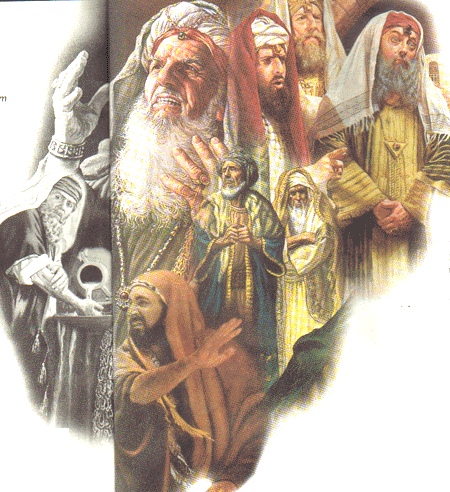
Read the entire text of Matthew, chapter 23. It is not an acquiescence to Pharisaic authority. Bar Tzadok also assumes that the Pharisees of this text are the same as that remnant of rabbis who were eventually set aside in those times (about the time that the gospels were being written), and who eventually codified the Mishna and laid the foundation for the development of the Talmud centuries later. There was much confusion in those times, much being concealed, and many ideas passing back and forth. (The text, however, ultimately, and prophetically speaks of the ecclesiastical authorities of Christianity, who are the Pharisees of our time). Nor was it in the interest of the early Church to tear souls away from the Jewish faith, or away from the written Torah, knowing as they did that both pillars of the Tree of life led directly into our times and to the reconciliation between the two that the Most High is about to accomplish. They were deeply concerned, however, for the things that have finally come to pass--for the things that the rabbis rejected in Paul and could not understand in the Gospels, nor in the Law and the Prophets, things that have led to the establishment of the Zionist State of Israel in the 20th century. Ephraim has gone backwards again--once again away from the teachings of the holy Sages. (Please see Chapter 10):
Mishna Tractate 14:4-8
(14.4) A. Before the tabernacle was set up, (1) the high places (altars for sacrifices outside of the Temple in Jerusalem) were permitted, and (2) the sacrificial service was done by the first born. (Num.3:12-21; 8:16-18).
(14.4) B. When the tabernacle was set up, (1) the high places were prohibited, and (2) the sacrifice service was done by priests.
(14.4) C. Most Holy Things were eaten within the veils, Lesser Holy Things (were eaten) throughout the camp of Israel.
(14.5) A. They came to Gilgal (The Great Circle of the Mystery of Adam).
(14.5) B. The High Places (of the Mystery) were prohibited.
(14.5) C. Most Holy Things were eaten within the veils, Lesser Holy Things were eaten anywhere...
(14.8) A. They came to Jerusalem
(14.8) B. The high places were prohibited.
(14.8) C. And they never again were permitted.
(14.8) D. And it was "the inheritance" (Deuteronomy 12:9).
(14.8) E. Most Holy Things were eaten within the veils, Lesser Holy Things and second tithe within the wall.
(Bar Tzadok continues): Now the question must be asked: did he himself listen to his own words. In other words, after acknowledging the authority of the Rabbis (which he did not in totality) did Yeshu himself listen to and follow the words of the Rabbinic judges. Let us turn now to the words and actions of Yeshu to see if he fulfilled the words of the Torah that he himself acknowledged.
YESHU AND THE SABBATH
Let no man therefore judge you in meat, or in drink, or in respect of an holyday, or of the new moon, or of the Sabbath days:
Which are a shadow of things to come; but the Body is of Christ...Colossians 2:16,17).
In Matt.12:1-7, we have recorded an episode relating to Yeshu's observance of the holy Sabbath. Now G-d has commanded in His Torah (Ex.31:15), whoever does work on the Sabbath day shall be put to death. We remember the episode of the man who went out and picked up sticks on the Sabbath and he was put to death (ref.Num.15:32-36)...
(Does Bar Tzadok actually want this precept to be enforced literally, as God rises up now to shake out of His Kingdom all things that offend, and especially if he, himself, is the one picking up sticks)?...
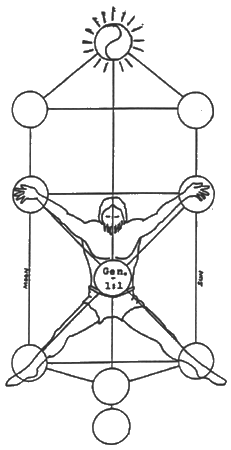
See that ye refuse not him that speaketh. For if they escaped not who refused him that spake on earth, much more shall we not escape, if we turn away from him that speaketh from heaven:
Whose voice then shook the earth, but now he hath promised, saying, Yet once more I shake not the earth only, but also heaven.
And this word, Yet once more, signifieth the removing of those things that are shaken, as of things that are made, that those things which cannot be shaken may remain...(Hebrews 12:25-29).
(Tzadoc continues): What then is Yeshu's relationship with regards to the Sabbath, to the Word of G-d and the authority of the Divinely ordained Rabbinic judges. Let us review Matt.12:1-7:
At that time Yeshu went on the Sabbath through the grain fields and his disciples became hungry and began to pick the heads of grain and ate. But when the Pharisees saw it, they said to him, "Behold, your disciples do what is not lawful to do on the Sabbath." But he said to them, "have you not read what David did...how he entered the house of G-d, and ate the consecrated bread, which was not lawful for him to eat...or have you read in the Law that on the Sabbath the priests in the temple break the Sabbath, and are innocent? But I say to you that something greater than the temple is here. But if you had known what this means, I desire compassion and not sacrifice you would not have condemned the innocent.
(Bar Tzadoc says) This section is so replete with errors that it broadly broadcasts Yeshu's lack of Torah education and knowledge of G-d's laws. To begin with, it is surprising to note that Yeshu's disciples were not learned enough to know that the picking of grain on the Sabbath was a violation of Biblical law, which under certain circumstances would lead to the death penalty. Yeshu should have taught them better, but judging from his response to the Pharisees, it might be understood that Yeshu, himself, did not know the law...
(First of all, it is this insistence on a purely literal interpretation of the law that keeps a maturing world from turning to the Jewish religion as a source of refuge. Who in their right spiritual mind could lean to a tradition that has brought upon itself all of the calamities of our times as it has? Judaism is the steward of the Torah, not its final interpreters).
When the Pharisees noticed Yeshu's disciples violating the Sabbath, they fulfilled their Biblical obligation of admonishment, as it is written, You shall reprove your fellow and do not bear sin because of him. (Lev.19:17). Instead of heeding the Rabbinic authorities and correcting their ways, like Yeshu said should be done (Matt.23:3..therefore all that they tell you do and observe) he instead attempts to justify the actions of his disciples and to challenge the authority of the Rabbis.
Yeshu makes reference to the Biblical story of David (1 Sam.21:4-6), saying how when he (David) was hungry the priests gave him and his men to eat of consecrated bread. Therefore if it is OK for the law to be broken for David, then surely it is OK for the law to be broken for Yeshu's disciples. This response of Yeshu makes no sense in light of Jewish law. You see, the priests did not violate the law in giving the bread to David and his men. Anyone with knowledge of Hebrew can research this law and see for yourselves that what the priests did was entirely allowable. Therefore, when Yeshu declared, they ate the consecrated bread, which was not lawful for him to eat, he was dead wrong in his analogy...
(Of course, anyone with knowledge of the true dimensions of the Holy Temple and the House of G-d will immediately understand the epic and prophetic import of Yeshu's words. Only the priests are permitted to enter the sacred precincts of the higher mysteries. Of course David, the Messiahs, have partaken of them also):
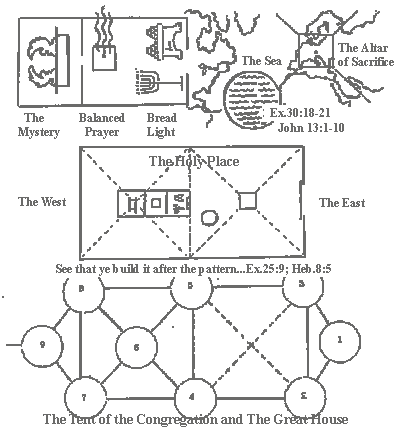
The Tabernacle of the Sun...Psalm 19:1-4.
Yeshu then attempts another analogy to justify his sinful behavior. He references the priests in the temple who break the Sabbath, and are innocent. One with the least knowledge of Torah law knows that temple sacrifice was commanded by G-d to be performed on the Sabbath (Num.28:9-10). It is not a violation of the Sabbath, it is the fulfillment of Sabbath law. Both of the rationalizations that Yeshu uses to justify his violation of the Torah law, instead of justifying his position, further condemns his actions. But the worst is yet to come...
(One with the least knowledge of Torah law knows that the Son of Man is lord of the Sabbath. Open up the pages of the Book of Ezekiel here at the Western ends of the Earth, in our very own time...
Seven days must ye eat unleavened bread...Exodus 12 and 13.
...One also understands that the High Priest alone, the son of Man, is permitted to enter the inner sanctuary of these Sacred Mysteries, into the Holy of Holies of the Great Tabernacle of God. Such a one may invite all who will, to enter with him. It is true, however, as Bar Tzadoc implies, Joshua is clothed in filthy garments. Zechariah 3 ).
Yeshu quotes the prophet Hoshea 6:6, I desire compassion and not sacrifice. Is this supposed to imply that G-d simply wants Jewish people to be compassionate and that the observance of Jewish law is a sacrifice and thus not important? Is it not written, My Sabbaths you must observe for it is a sign between Me and you for your generations. (Ex.31:13) and Between Me and the children of Israel it is a sign forever. (Ex.31:16). Does something that is forever and for your generations come to an end? Did G-d, Himself, not say, whoever does work on the Sabbath day shall be put to death. (Ex.31:15)...
Is it not written:
"Woe to those who see in the Law only simple narratives and ordinary words. Were this really the case, then we could even today comprise a law equally worthy of admiration. But it is all quite otherwise...Every word of the Law contains an elevated sense and a sublime mystery. The narratives of the Law are but the raiment in which it (the higher Law) is clothed. Woe to him who mistakes the garment for the Law itself.
It was to avert such a calamity that David prayed, 'Open my eyes that I may behold wondrous things out of thy Law,' (Psalm 119:18)." Introduction to the Zohar.
"The Rabbin speaks of the complete abolition of the commandments. (Talmud Nid 61b). This was interpreted by the kabbalists to refer to the complete spiritualization of the Law under the dominion of the Tree of Life." Kabbalah, by Gershom Scholem, p.166.
Did not Paul say:
But now we are delivered from the law, that being dead wherein we were held, that we should serve in the newness of the spirit, and not in the oldness of the letter.
What shall we say then? Is the law sin? God forbid. Nay, I had not known sin, but by the law: for I had not known lust, except the law had said, Thou shalt not covet.
But sin, taking occasion by the commandment, wrought in me all manner of concupiscence, (spiritual conflict). For without the law sin was dead.
For I was alive without the (true meaning of the) law: but when the commandment (the true meaning) came, sin revived, and I died. (Thus the law had its full effect).
And the commandment, which was ordained to life, I found to be unto death.
For sin, taking occasion by the commandment, deceived me, any by it slew me.
Wherefore the law is holy, and the commandment holy, and just, and good...(Romans 7:6-12).
And is it not written of the Great Seventh Day...
But with whom was He grieved Forty years? was it not with them that had sinned (against the true meanings of the law), whose carcases fell in the wilderness?
And to whom sware He that they should not enter into His rest, but to them that believed not?
So we see that that they could not enter in because of unbelief.
Let us therefore fear, lest a promise being left us of entering into His rest, any of you should seem to come short of it.
For unto us was the gospel preached, as well as unto them: but the word preached did not profit them, not being mixed with faith in them that heard it.
For we which have believed do enter into rest, as He said, As I have sworn in my wrath, if they shall enter into my rest: although the works were finished from the Foundation of the world.
For He spake in a certain place of the Seventh day on this wise, And God did rest on the Seventh day from all His works. (Genesis 2:1-4...understand the import).
And in this place again, If they shall enter into my rest.
Seeing therefore it remaineth that some must enter therein, and they to whom it was first preached entered not in because of unbelief...(Hebrews 3:17 to Heb.4:6).
(Forgetting the precept that says, Levi shall teach Jacob statutes, and Israel thy laws, Tzadoc goes on to say), Instead of accepting the admonishment of the Rabbinic Sages (who are of Judah and not Levi), which we have no reason to doubt was offered in good faith, Yeshu contradicts himself, and denies the authority and admonition of the Rabbis. By his own actions and words, Yeshu not only violated the Sabbath, but he also refused to accept the authority of the Rabbinic judge, which he, himself says must be listened to.
Yeshu violated the Sabbath and so did his disciples. Yeshu displayed an appalling lack of knowledge of the Torah and acted with contempt towards the Rabbis whose job it was to admonish him, a job which Yeshu, himself, acknowledges. And so, I ask you, are these the deeds of a messiah?
Yeshu said, The man old in days will not hesitate to ask a small child Seven Days Old about the place of Life, and he will live. For many who are first will become last, and they will become one and the same...(Gospel of Thomas 4).
Yeshu said, If you do not fast as regards the world, you will not find the kingdom. If you do not observe the Sabbath as a Sabbath, you will not see the Father...(Gospel of Thomas 27).
YESHU AND THE LAW
There are yet other episodes to be covered that conclusively show Yeshu violating G-d's command outlined in Deut.17:11, You shall not deviate from the word that they will tell you, right or left.
In one episode, recorded in Mark 7:1-8, we not only have another clear record of Yeshu's violating G-d's word...we also are given a glimpse into a much uglier side of Yeshu's personality.
And the Pharisees and some of the scribes gathered around him when they had come from Jerusalem, and had seen that some of his disciples were eating their bread with impure hands, that is, unwashed. For the Pharisees and all the Jews do not eat unless they carefully wash their hands, thus observing the traditions of the elders; and when they come from the market place they do not eat unless they cleanse themselves, and there are many other things which they have received in order to observe, such as the washing of cups and pitchers and copper pots. And the Pharisees and scribes asked him, "Why do your disciples not walk according to the tradition of the elders, but eat their bread with impure hands?" And he said to them, "Rightly did Isaiah prophesy of you hypocrites, as it is written, 'This people honors me with their lips, but their heart is far away from me, but in vain do they worship me, teaching as doctrines the precepts of men.' (Is.29:13). Neglecting the commandment of G-d, you hold to the tradition of men."
This scene opens with an innocent visit by the Pharisees to the students of Yeshu (Bar Tzadoc reasons). Nowhere is there implied any form of maliciousness on behalf of the Pharisee visitors. (Save for the fact that we are told elsewhere that they were always trying to ensnare him in his own words). When, however, the Pharisees again see Yeshu's disciples violating a principle of the Rabbis, these Pharisees ask, isn't it written, According to the teaching that they will teach you and according to the judgment that they will say to you, shall you do, you shall not deviate from the word that they will tell you, right or left. (Deut 17).
In light of this, the Pharisees and scribes asked him, "Why do your disciples not walk according to the tradition of the elders, but eat their bread with impure hands?" Here Yeshu is given another excellent opportunity to appropriately respond to the Rabbis by accepting admonishment and by correcting the ways of his disciples. Yet instead of doing what Torah demands, Yeshu, again, goes on the offense against G-d's holy servants. Yeshu strikes out against the innocent Rabbis calling them hypocrites. But why? The story...does not reveal any trace of hypocrisy on behalf of the Rabbis. Yeshu was asked a simple question. He responded with an attack...
For the word of God is quick, and powerful, and sharper than any twoedged sword, piercing even to the dividing asunder of soul and spirit, and of the joints and marrow, and is a discerner of the thoughts and intents of the heart...(Hebrews 4:12).
Yeshu continues to quote a verse from the prophet Isaiah to validate his position condemning the Rabbis. Yet, when the verse in Isaiah is looked at within its proper context, it can be clearly seen that the verse has nothing to do with what Yeshu is talking about. In fact, Yeshu does not even quote the verse correctly...
Bar Tzadok is now grasping at straws. If the verse in Isaiah so much as hinted, ever so slightly, that one could be ensnared by following the traditions of men rather than the higher implications of the Law itself, a person would do well to follow their own heart instead (as so many Jews and Christians have over the centuries since the time of Christ)...
Yeshu said, Blessed are the solitary and elect, for you will find the kingdom. For you are from it, and to it you will return.
Yeshu said, If they say to you, Where did you come from? say to them, We came from the light, the place where the light came into being on its own accord and established itself and became manifest...If they say to you, Is it you? say, We are its children, and we are the elect of the living Father. If they ask you, What is the sign of your Father in you? say to them, It is movement and repose...(Gospel of Thomas 49, 50).
And if such souls happened to fall in with a fellowship of others who are also following their own hearts (as so many have), and if such hearts were without guile and pure in the sight of God, they might all wind up in company with the true messiah. For most certainly, among the orthodox Jews of our time, there is a fellowship gathered around the true Anointed Ones, the Messiahs of DaViD--waiting for those events that will bring about their manifestation to the world.
While we are trying in this chapter to get past, and through the mutual discrepancies and failings that keep Jews and Christians from coming together and seeing eye to eye (it is the same religion you know), this seems to be the place in this discussion to interject some teachings from the Talmud itself, teachings that almost every Jew will agree do not actually (any longer) reflect the world-view of the Jewish people--but not before clearly admitting that almost everything, every indictment and every resentment, and every ill-feeling the Jews have against Christianity, are well-founded and true. Christianity has been both a good thing and an evil thing in the earth, and this because passing through the Era of Wickedness the sons of Darkness have made up more than half of its congregation, and still do. (2 Peter 2, the Book of Jude). Concerning the excerpts from the following tractate, we will not comment on any part of it. We will simply add them here for the record, and then, God willing, exorcise all of it from our thinking:
THE TRUTH ABOUT THE TALMUD
JUDAISM'S HOLIEST BOOK
by Michael A. Hoffman & Alan R. Critchley
The Talmud is Judaism's holiest book(s)...Its authority takes precedence over the Old Testament in Judaism. Evidence may be found in the Talmud itself. Erubin 21b (Soncino edition): "My son, be more careful in the observance of the words of the Scribes than in the words of the Torah."
(We said that we would not add any comments, but it is hard not to: The Talmud is Judaism's recognition that the Torah is indeed comprised of precepts and statutes, historical allegories and epic metaphors, that do require the insights of those learned in the ways of Law. By the time the Mishna is codified, toward the end of the 2nd century A.D., and the Talmuds are composed over the following centuries, the belief against Christianity is dogmatically sealed in the minds of the Rabbis, for reasons that are very evident. Even if they wanted to include something in their own ongoing commentary that came close, or supported any of the doctrines of Christianity, they would be compelled to reconfigure such ideas in purely non-Christic terms. Of course they were not entirely successful. A reading, for instance, of Everyman's Talmud, The Major Teachings of the Rabbinic Sages, is a basic primer for the reconciliation of the two faiths--when one understands the Kabbalistic foundations of Christianity that is...
"The basic purpose of the Talmud was to provide the Jewish people with a body of teaching which should be more than a creed, but also a guide of life in every phase. It created the world in which the Jew moved and had his being. From the roots of the six hundred and thirteen precepts contained in the Pentateuch there grew a Tree with numerous branches, the fruits of which provided the daily spiritual sustenance of whoever cared to avail themself of them." Everyman's Talmud, by Abraham Cohen, p.149.
(Back to Hoffman and Critchley, with the stipulation that we do not agree with, or espouse, all of its assertions--save for those that are flagrantly evident and applicable to the conditions that Judaism finds itself in our time. It is for the most part our brother Bar Tzadok in American Identity garments. We assume that they do not want to offend anyone, but we know they will):
THE TALMUD NULLIFIES THE BIBLE
The Jewish Scribes claim the Talmud is partly a collection of traditions Moses gave gave them in oral form. (Which it is in its earliest form). These had not been written down in Jesus' time. Christ condemned the traditions of the Mishna (early Talmud) (which he didn't) and those who taught it...because the Talmud nullifies the teachings of the Holy Bible (which it does in places)..
Shmuel Safrai in The Literature of the Sages Part One (p.164), points out that in chapters 4 and 5 of the Talmud's Gittim Tractate, the Talmud nullifies the Biblical teaching concerning money-lending. "Hillel decrees the prozbul for the betterment of the world. The prozbul is a legal fiction which allows debts to be collected after the Sabbatical year and it was Hillel's intention thereby to overcome the fear that money-lenders had of losing their money."
(Something to consider, seeing how the evil money-lenders are now in charge of the Western world. The prozbul nevertheless is a rendering of Deut.15:1-3. The conflict lies in the question, Who is a foreigner, and who is my brother)?
The famous warning of Jesus Christ about the traditions of men that voids Scripture (Mark 7:1-13), is in fact, a direct reference to the Talmud. (The authors contend that Jesus condemned the Mishna, but this is not true. The Mishna is that very basis of Talmudic reasoning that the early Jewish-Christians shared with the Rabbis to begin with)...Unfortunately, due to the abysmal ignorance of our day, the widespread "Judeo-Christian" notion is that the Old Testament is the supreme book of Judaism. But this is not so. The Pharisees teach for doctrine the commandments of men. (Which is true in part, but so does Christianity). The Talmudic commentary on the Bible is their supreme law, and not the Bible itself. That commentary does indeed, as Jesus said, void the laws of God, not uphold them. As students of the Talmud we know this is to be true.
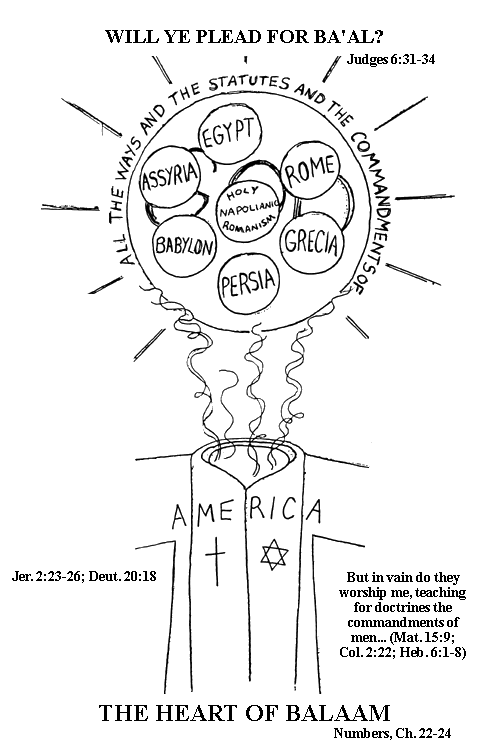
The admonition is against both Judaism and Christianity.
There is a tiny Jewish sect which makes considerable effort to eschew Talmud and adhere to the Old Testament alone. These are the Karaites, a group which, historically, has been the most hated and severely persecuted by orthodox Jewish rabbinate...
This study is based on the Jewish authorized Babylonian Talmud. We have published herein the authenticated sayings of the Jewish Talmud. Look them up for yourself. We publish them in the hope of liberating all people, including Jewish people, from the corrosive delusions and racism of this Talmudic hate literature, which is the manual of Orthodox and Hasidic Jews the world over.
The implementation by Jewish supremacists of Talmudic hate literature has caused untold suffering throughout history and now, in occupied Palestine, it is used as a justification for the mass murder of Palestinian civilians. The Talmud specifically defines all who are not Jews as non-human animals.
SOME TEACHINGS OF THE JEWISH TALMUD
Erubin 21b. Whosoever disobeys the rabbis deserves death and will be punished by being boiled in hot excrement in hell.
Moed Kattan 17a. If a Jew is tempted to do evil he should go to a city where he is not known and do the evil there.
Sanhedrin 57a. A Jew need not pay a gentile ("Cuthean") the wages owed him for work.
Sanhedrin 57a. When a Jew murders a gentile ("Cuthean"), there will be no death penalty. What a Jew steals from a gentile he may keep.
Sanhedrin 58b. If a heathen (gentile) hits a Jew, the gentile must be killed.
Baba Kamma 37b. If an ox of an Israelite gores an ox of a Canaanite there is no liability; but if an ox of a Canaanite gores an ox of an Israelite...the payment is due in full.
Baba Kamma 37b. The gentiles are outside the protection of the law and God has "exposed their money to Israel."
Baba Mezia 24a. If a Jew finds an object lost by a gentile ("heathen") it does not have to be returned. (Affirmed also in Baba Kamma 113b). Sanhedrin 76a: God will not spare a Jew who "marries his daughter to an old man or takes a wife for his infant son or returns a lost article to a Cuthean..."
Baba Kamma 113a. Jews may use lies ("subterfuges") to circumvent a gentile. (We can understand this one).
Yebamoth 98a. All gentile children are animals. (Of course those who behave as animals are as animals).
Abodah Zarah 36b. Gentile girls are in a state of niddah (filth) from birth.
Abodah 22a-22b. Gentiles prefer sex with cows.
INSULTS AGAINST BLESSED MARY (Satu Mare)
Sanhedrin 106b, says Jesus' mother was a whore: "She who was the descendant of princes and governors played the harlot with carpenters." (Consider Zechariah 1:20,21). Also in footnote #2 to Shabbath 104b of the Soncino edition, it is stated that in the "uncensored" text of the Talmud it is written that Jesus mother, "Miriam the hairdresser," had sex with many men.
Yeshu said, He who knows the Father and Mother will be called the son of a harlot...(Gospel of Thomas 105).
GLOATS OVER CHRIST DYING YOUNG
A passage from Sanhedrin 106 gloats over the early age at which Jesus died. "Hast thou heard how old Balaam (Jesus) was?...He replied: It is not actually stated but since it is written, Bloody and deceitful men shall not live out half their days it follows that he was thirty-three or thirty-four years old."
Sanhedrin 43a says Jesus (Yeshu) was executed because he practiced sorcery.
(The Book of Revelation also passes a sentence against Balaam, a sentence which passes to the whole of Christianity...Rev.2:12-17. And a charge of sorcery can be levied against Christianity as well, as it says of the the Antichrist in the last days: And he decieveth them that dwell on the earth by means of those miracles which he had power to do in the sight of the beast...Rev.13:12-14).
Sanhedrin 43a. "On the eve of Passover Yeshu was hanged...Do you suppose that he was one for whom a defense could be made? Was he not a Mesith (enticer)?"
Rosh Hashaah 17a. Christians (minnim) and others who reject the Talmud will go to hell and be punished there for all generations.
Sanhedrin 90a. Those who read the New Testament ("uncanonical books") will have no portion in the world to come.
Sabbath 116a. Jews must destroy the books of Christians...
NON-JEWS ARE NOT HUMAN
The Talmud specifically defines all who are not Jews as non-human animals, and specifically dehumanizes gentiles as not being descendants of Adam:
Kerithoth 6b. Uses of Oil of Anointing, Our Rabbis have taught: He who pours the oil of anointing over cattle over cattle or vessels is not guilty; if over gentiles or the dead, he is not guilty. The law relating to cattle and vessels is right, for it is written: "Upon the flesh of man (Adam) shall it not be poured (Exodus 30:32); and cattle and vessels are not man (Adam)...
Yebamoth 61a. "It was taught: And so did R. Simeon ben Yohai state that the graves of gentiles (goyim) do not impart levitical uncleanness, by an ohel...for it is said, 'And ye my sheep the sheep of my pasture, are men (Adam),' (Ezekiel 34:31), you are called men (Adam) but the idolaters are not called men (Adam)."
The Mosaic law states that touching a Human Corpse or grave imparts uncleanness to those who touch it. But the Talmud here teaches that if a Jew touches the grave of a gentile, it does not make him unclean, since gentiles are not human (literally, Adam).
Baba Mezia 114b. "Said he (Rabbah) to him: Art thou not a priest: why then dost thou stand in a cemetery? He replied: Has the Master not studied the law of purity? For it has been taught: R. Simeon Ben Yohai said: The graves of gentiles (goyim) do not defile, for it is written (again, Ezekiel 34:30,31).
Since the supposed Biblical proof text (Ezekiel 34:30,31) repeatedly cited above...in reality does not prove that only Jews are human (Adam), it is evident that Talmudic sages who asserted the preceding absurdities about gentiles were already anti-gentile racists or ideologues who, in desperate search of some proof of their position, distorted an Old Testament passage in order to justify their bigotry...
MOSES MAIMONIDES: ADVOCATE OF EXTERMINATION
"Moses Maimonides is considered the greatest codifier and philosopher in Jewish history. He is often affectionately referred to as the Rambam"...Here is what (the Rambam) taught concerning saving people's lives, especially concerning saving the lives of gentiles and Christians, or even Jews who dared to deny the "divine inspiration" of the Talmud:
Maimonides, Mishna Torah, (Moznaim Publishing Corporation, Brooklyn, New York, 1990, chapter 10, English Translation), p.184: "Accordingly, if we see an idolater (gentile) being swept away or drowning in the river, we should not help him. If we see that his life is in danger, we should not save him."..."It is a mitzvah (religious duty), however, to eradicate Jewish traitors, minnim, and apikorsim, and to cause them to descend to the pit of destruction, since they cause difficulty to the Jews and sway the people away from God, as did Jesus of Nazareth and his students, and Tzadok, Baithos, and their students. May the name of the wicked rot."...
The commentary also states that the students of Tzadok were defined as those Jews who deny the truth of the Talmud and who uphold only the written law (i.e. the Old Testament).
According to Maimonides' Principles, p.5, Maimonides "spent twelve years extracting every decision and law from the Talmud, and arranging them all into 14 systematic volumes." The work was finally completed in 1180, and was called Mishna Torah, or "Code of the Torah."...In the Mishna Torah Maimonides taught that...gentiles are not human..."neither gentiles nor cattle are susceptible to any uncleanness. (They are irrelevant to the precept or statute in question)."
The Babylonian Talmud, Sanhedrin 37a, restricts the duty to save life to only Jewish lives. The book of Hebrew censorship, written by Jews themselves (Hesronot He-shas), notes that some Talmud texts use the universalist phrase: "Whoever destroys the life of a single human being...it is as if he had destroyed an entire world; and whoever preserves the life of a single human being...it is as if he had preserved an entire world." However, Hesronot Ha-shas points out that these are not the authentic words of the original Talmud...the original Talmud text states that "whoever preserves a single soul of Israel, it is as if he had preserved an entire world." The original Talmud text sanctions only the saving of Jewish lives. (continued)...
On the other hand
PERSPECTIVES ON THE 'ST. JOHN PASSION' AND THE JEWS
by Michael Marissen
Among Martin Luther's best-known writings today is his screed "On the Jews and Their Lies," from 1543. There Luther suggested sanctions for Jews who would not embrace his Christianity: burn their places of worship, destroy their homes, seize their prayer books and Talmudic writings and finally expel them from areas of Europe...
Now that Bach's indebtedness to Luther has come to be widely acknowledged, listeners could easily assume that Bach harbored hostility to Jews and, accordingly, that his music projects such hostility. Throw in his engagement with the Gospel of John, with its continual harping "on the Jews" as inimical to Jesus, his followers and truth in general, and one might reasonably wonder whether there is even any room for discussion...
John contains many references to "the Jews," and no attentive reader can fail to notice that they are overwhelmingly negative. In this Gospel, the cosmos is engaged in a battle. On one side, there are God the Father, Good, Heaven, Light, and Jesus and his followers. On the other, Satan, Evil, the World, Darkness and "the Jews"...
The puzzling thing, from a historical point of view, is why John calls Jesus' opponents "the Jews" when he knows that Jesus was a Jew...as were his disciples...In a significant bit of wordplay by John, The Jewish high priest Caiaphas unwittingly prophesies when he provides the historically most plausible reason for "the Jews" to hand Jesus over to the Romans (John 11:49-52; 18:14): "It would be good that one man be put to death instead of the people," this because of the social unrest the one man, Jesus, would cause during the pilgrimage festival of Passover...
In spite of John's notion that Jesus "is the lamb of God who takes away the world's sin" (1:29)...the sad fact remains, as Samuel Sandmel observed in his book A Jewish Understanding of the New Testament, that "in its utility for later Jew-haters, the Fourth Gospel is pre-eminent among the New testament writings."
JEWISH DECEPTION AND DISSIMULATION
(Continued)...The response of the othodox rabbis to documentation regarding the racism and hatred in the Talmud is simply to brazenly lie, in keeping with the Talmud's Baba Kamma 113a which states that Jews may use lies ("subterfuge") to circumvent a gentile.
The Simon Weisenthal Center, a multi-million dollar rabbinical propaganda center dispatched Rabbi Daniel Landes in 1995 to deny that the Talmud dehumanizes non-Jews. "This is utter rot," he said. His proof? Why, his own word, of course...
In 1994, Rabbi Tzvi Marx, director of Applied Education at the Shalom Hartman Institute in Jerusalem, made a remarkable admission concerning how Jews in the past have issued two sets of texts: the authentic Talmud texts with which they instruct their own youths in the Talmud schools (kollel) and "censured and amended" versions which they disseminate to the gullible goyim for public consumption...
(The authors' reasonings begin to fall apart now, just as Bar Tzadoc's does, when they speak of things beyond their understanding, as if they understood them):
It is not for nothing that the authoritive edition of the Talmud is known as the Babylonian Talmud. As Christians misled by their Judaizing preachers and popes are increasingly consulting Jewish rabbinic sources for a "pure" understanding of the Old Testament, they are unknowingly consulting the occult.
Judaism is the religion of the Pharisees and the patrimony of Babylon, from whence the Talmudic and Kabbalistic traditions of Judaism ultimately derive. Orthodox Judaism's other sacred book, the Kabbalah, is filled with astrological teachings, fortune-telling, gematria, necromancy and demonology...Furthermore, the Israeli "Star of David" is actually nothing of the kind, but rather an occult hexagram which became associated with the Khazars in 14th century Bohemia. (The mis-named "state of Israel" was founded in 1948 in an alliance between Jewish Communists and atheistic Zionists, with crucial U.N. recognition provided by Soviet Communist dictator Joseph Stalin)...
Orthodox rabbis place curses, cast spells and imagine they have powers greater than God, derived from their study of the Sefer Yeyzirah (a book of Kabbalistic magic). Christians are trafficking in Babylonian paganism when they defer to the rabbis of Judaism.
Christianity is the only true religion of the Bible. It was founded by Israelites who adhered to the Torah and who recognized in Christ's gospel of salvation through grace, the fulfillment of the Old Testament. It is the followers of Jesus who constitute the holy nation and the royal priesthood (1 Peter 2:9). Independent History and Research, Coeur d'Alene, Idaho.
(RETURNING NOW TO BAR TZADOK):
In the version of this episode in Matt.15:1-9, Yeshu's response to the question of hand washing is answered by changing the subject. Here, Yeshu brings up the topic of vows to G-d. He condemnes the law which states that devotion to G-d comes before devotion to one's parents. This is a queer thing for Yeshu to say when he himself has previously said, He who loves father and mother more than me is not worthy of me. (Matt.10:37).
It is true, that which is devoted to G-d becomes the property of the temple. But Yeshu here insinuates that adult children are intentionally dedicating their financial goods to the temple just so as to deprive their elderly parents of support. >From where did Yeshu derive this idea? This, indeed, would be a cruel thing for anybody to do. Granted, it is a lawful thing to do, but why would anyone give away to the temple something that could and would stay in the family? Yeshu's argument simply does not make any economic sense. In all of Jewish literature relating to the topic of vows and the temple, we do not find even one instance or reference to anything similar to what Yeshu is referring. And besides, what does all this have to do with the washing of hands? That was the original topic. Instead of dealing with the issue, Yeshu avoided it.
(Well first of all, Yeshu's response was not a direct answer to the question. He was instead likening his disciples' disregard for the tradition of hand washing to the Pharisee's disregard for the actual commandment to Honor, not merely thy father and mother, but The Father and Mother--God Themselves, the oldest parents of all. And then he implied that the Pharisees break this commandment by violating another on the way, one that has everything to do with hand washing and foot washing, and being set free:
And the Lord called unto Moses, and spake unto him out of the tabernacle of the congregation, saying:
Speak unto the children of Israel, and say unto them, if any man of you bring an offering unto the Lord, ye shall bring your offering of the cattle, even of the herd, and of the flock, (in other words, one must bring themself, their whole self, every thought, every emotion, and every desire).
If his offering be a burnt sacrifice of the herd, let him offer a male without blemish (and this word male opens up a whole other set of meanings), HE SHALL OFFER IT OF HIS OWN VOLUNTARY WILL AT THE DOOR OF THE TABERNACLE OF THE CONGREGATION BEFORE THE LORD...(Leviticus 1:1-3).
Yeshu's temple is the whole world, and the Doorway to the Greater Tabernacle is situated in the heart and mind of every child of God...
Know ye not that ye are the temple of God, and that the Spirit of God dwelleth in you?
If any man defile the temple of God, him shall God destroy: For the temple of God is holy, which temple ye are...(1 Corinthians 3:16,17).
__________
One thing have I desired of the Lord, , that will I seek after; that I may dwell in the house of the Lord all the days of my life, to behold the Beauty of the Lord, and to inquire in His temple...(Psalm 27:4).
__________
Now therefore ye are no more strangers and foreigners but fellow citizens with the saints, and of the household of God.
And are built upon the Foundation of the apostles and prophets, Jesus Christ (Hesus-Crishna) himself being the chief corner stone;
In whom all the building fitly framed together, groweth unto a holy temple in the Lord.
In whom ye are also builded together for an habitation of God through the Spirit...(Ephesians 2:13-22).
Please see that the Arms and the Hands of this Mystery are in the East, while the Feet are in the West.
Thou shalt make a laver of brass, and his foot also of brass, to wash withal: and thou shalt put it between the tabernacle of the congregation and the altar, and thou shalt put water therein.
For Aaron and his sons shall wash their hands and feet thereat:
When they go into the tabernacle of the congregation, they shall wash with water, that they die not; or when they come near to the altar to minister, to burn offering made by fire unto the Lord:
So shall they wash their Hands and their Feet, that they die not: and it shall be a statute for ever to them, even to him and to his seed throughout their generations...(Exodus 30:18-21).
__________
Yeshu knowing that the Father had given all things into his hands, and that he was come from God, and went to God;
He riseth from supper, and laid aside his garments; and took a towel and girded himself.
After that he poureth water into a basin, and began to wash the discIples Feet, and to wipe them with the towel wherewith he was girded.
Then cometh he to Simon Peter: and peter saith unto him, Lord, dost thou wash my Feet?
Jesus answered and said unto him, WHAT I DO THOU KNOWEST NOT NOW, BUT THOU SHALT KNOW HEREAFTER..
Peter saith unto him, Thou shalt never wash my Feet. Jesus answered him, If I wash thee not, thou hast no part with me.
Simon Peter saith unto him, Lord, not my Feet only, but also my Hands and Head.
YESHU SAITH UNTO HIM, HE THAT IS WASHED NEEDETH NOT SAVE TO WASH HIS FEET, but is clean every whit: and ye are clean but not all.
For he knew who should betray him; therefore he said, Ye are not ALL clean.
So after he had washed their Feet, and had taken his garments, and was set down again, he said unto them, KNOW YE WHAT I HAVE DONE TO YOU?...(John 13:1-18).
(Bar Tzadok): In the version in Mark, Yeshu concludes his attack by saying, Neglecting the commandment of G-d, you hold to the tradition of men, yet which commandments of G-g, the Pharisees are accused of neglecting is not mentioned.
(By bringing oneself to the temple made with hands, and to the traditions of men, one not only binds themself to men, and all their imperfect ways, but dishonors those whose Temple is the whole world and who dwells in every living being).
Yeshu said, Whoever does not hate his father (his old nature) and his mother (his old interpretations of reality) as I do cannot become a disciple to me. And whoever does not love his (true) father and his (true) mother as I do cannot become a disciple to me. For my mother...but my true mother (the Higher Law) gave me life...(Gospel of Thomas 101).
YESHU AND THE RABBIS
One message comes through loud and clear throughout the four gospels: Yeshu did not get along at all with the Pharisaic Rabbinic leadership of his day. The Christian will, of course, fault the Rabbis for being religious bigots and hypocrites. Yet, exact details of just what hypocrisy individual Rabbis have done is never mentioned. Also, since when is an entire group to be condemned for the mistakes of only a few? Granted, there must have been some Rabbis who were not the epitome of righteousness and holiness. We are, after all, only humans. But why should Yeshu, a prospective messiah in the eyes of his disciples, seek to condemn the entire Rabbinate? The Rabbinate, was created by G-d. Deut.17 clearly documents this
Again, the Christian will answer by referring to the hypocrisy of the Rabbis. Yet, the Christian is simply repeating Yeshu's unfounded accusations. What hypocrisy are we talking about? Yeshu only makes general accusations against an entire group of people (ref. Matt.6:2-5, 23:4-7). We have words to describe this type of behavior: sterotype prejudice. More than this, with his condemnations and foul, violent language, Yeshu violates a number of Biblical commandments..
When asked (Matt.22:36-40) what is the greatest of commandments, Yeshu responds that the love of G-d and the love of neighbor are the two most important. On these two commandments depend the whole law. In light of Yeshu's stereotypical prejudice against the Pharisaic Rabbis, let us review his own words as to how he fulfills the commandment to love your neighbor as yourself. (Lev.19:18; Matt.22:39). With regards to the Rabbis (Pharisees), who are his neighbors, Yeshu says in Matt.23:23-33:
Woe to you scribes and Pharisees, hypocrites. You blind guides...thay are full of robbery and self indulgence. You blind Pharisees...For you are like whitewashed tombs which on the outside appear beautiful but inside they are full of dead men's bones and all uncleanness. (Think about the human relics in Catholic altars). Even so you too outwardly appear righteous to men, but inwardly are full of hy[pocrisy and lawlessness...You serpents, you brood of vipers...
Are these the words of a dissenting Jew or are they the words of a Nazi anti Semite? If I didn't know any better, I would swear these words belonged to the latter. Whatever happened to According to the teaching that they will teach you and according to the judgment that they will say to you, shall ye do, you shall not deviate from the word that they will tell you, right of left. (Deut.17)? Whatever happened to Love your neighbor as yourself ?
Yeshu's vicious attack against the Pharisees violates both of these laws as well as these other Biblical laws: You shall not go up and down as a talebearer among your people. You shall not hate your brother in your heart. You shall not bear a grudge against the children of your people. (Lev.19:17-18)...
Yeshu is clearly making a personal attack on a group of fellow Jews, in gross violation of the Torah...He takes a stand very clearly against the authorities that G-d Himself has ordained, and to which Yeshu, himself, has acknowledged as authorities.
Those who call themselves Jews today are by and large indignant at the way the term is used in the New Testament to describe those who opposed and persecuted Christ. And this indignation flows from the general belief, not merely that they are the only true Jews but that they have always been, and therefore, that the Gospels must necessarily be referring to them. Normative Judaism as we know it today springs from that sect of Jews who were set aside by God out of all other groups of Jews in the time of Christ--actually, after the time of Christ. They were set aside, despite their unbelief it seems, but because of their zealous refusal to see the Torah spiritualized out of existence, or to see it perverted as they perceived it to be by the world around them, by the Greeks, the Hasmoneans, the Saddducees and the Zealots--and what of these Essenes? We are already seeing how the lines of communication were opened between the Essenes and these Pharisees, and how the one was secretly informing the other. Realize also, that the Talmud, and therefore the "Jews" of Christ's time, knows nothing of the events being described in the Gospels. "When did we do this?" "How did it happen?" "Where did it happen." "Who is this Yeshu?" Finding itself accused a hundred years or more later, as the Christian story of initiation began to circulate, of things it knew nothing of, Judaism had to reach back into its own archives and come up with the Jeschu stories to make sense of it, or to rationalize it to themselves and (at their own peril at times) to others. What we have in the Christian narratives, however, is a classic case of "If the Shoes fits wear it." For just as the Gospels imply a Universal Israel, and a Cosmic Christ (who is killed every day by Jews, Christians, Hindus, Muslims, Buddhists, agnostics, humanists, and all others who partake in the rituals of human warfare and execution), so are they also referring to the Universal Jew, of which the whole world was filled in those times...Jews in Egypt and Africa, Jews in the East, Jews in Europe, in Rome, in Athens, in Britain, in India, in America, Jews everywhere. They are referring to all who made a claim to the God of Israel (there is only ONE God), or even in the least wise to the doctrines and the teachings of Israel--which are comprised of the doctrines of all the other world-religions combined.
And then this indignation flows from the fact that as the emerging World-church (which had not grasped the hidden message of the Gospels to begin with), came to power, it began to harass and then eventually persecute those who still called themselves Jews (just as it did, however, to the true Christians and all those others heretics and dissidents over the centuries that it could not distinguish from each other, other than the collective fact that they would not adhere to the teachings and the authority of the now powerful and imperial World-church). As this World-church began to encourage its followers (the mindless masses), to consider these Jews Christ-killers it could not see--in its own lofty sense of itself--that it had become the Jews who were persecuting and killing Christ.
Likewise the religious world today is divided, as the world was then, into three basic levels of attachment to the affairs of the world itself. We understand it in the words: Take heed and beware of the leaven of the Pharisees and Sadducees (Matthew 16:6-12), and in our understanding now of the existence of that third class in Israel, the Essenes. This latter class gave us, or rather helped preserve for us, the Qumran library which assists us in all of our present conclusions. Certain members of this class, among whom John the Baptist appeared in those times, also gave us the Gospels which, along with the works of Josephus, help us in our definition of the differences that existed between these three classes:
The Sadducees are the worldly and the "purely ethical." They are the temple elite. They are aligned with and friendly with the powers of the age. They associate their fate, here in the West, with the fate of Politic-America. They believe in no culminating events in history, no Messiah, no Resurrection, and stay busy elevating the souls of men into the status-quo. They are religious, unspiritual, and generally affluent, exploiting not only the religious sentiments of the other echelons of society, but along with them the great bounty that God has provided for the benefit of all. The Sadducees of old were scattered (into other forms of Jewishness), or perished, when God sent the Romans down to destroy that city and that temple made with hands. (Please be mindful that Moscow is called the Third Rome). In terms of the Mystical Body they are the "flesh," or that which is enslaved to serve the spirit. They are in bondage and cannot enter the kingdom of heaven.
The Pharisees: these live in two worlds. They know there is a mystery, an oral tradition, a world above and a world below. They war in the spirit against the world below, but when expedient they will forsake the higher world for the lower. They will, if it serves their interests, kill for things "below," even sacrificing their sons and daughters to the "Consuming Fire." (Deuteronomy 4:1-39; Hebrews 12:12-29). This because they fight two wars, and carry two swords. They know there is a mystery, but they do not know it; an oral tradition, but they do not know its precepts. Yet they know in part. They are above and below. They know there is a resurrection, and they study and prepare for it, but they stumble over its meanings. They cling to the "letter" and oppose the Spirit. They are divided in affection between the Sadducees and the Essenes.
The Essenes (and by this we mean those who gave themselves over to the teachings of John the Baptist, and eventually Paul) are the remnant in every generation. They go by many names and no names at all. They live closest to God, and the Holy Spirit is at home in their hearts. They are free from the trammels of their age because they bind themselves to the inner meanings of God's laws. They do not kill, nor do they search the scriptures for permission to do so, knowing how these interpretations are reserved for the children of Darkness. They are found among the other two classes, but mostly they are found where their sentiments reside--laboring in various ways for and among the poor, the oppressed, and the infirm. They are found in communities of like-minded individuals, or in no communities at all. Some are still found living alone in contemplation, overcoming not only the collective transgressions of their age but the private transgressions of their own hearts. They live by the Eightfold Precepts and by the Sermon on the Mount.
__________
"As for the Pharisees, they say that certain events are the work of Fate, but not all; as to other events, it depends upon ourselves whether they shall take place or not. The sect of the Essenes, however, declare that fate is the mistress of all things, and that nothing befalls men unless it be in accordance with her decree. But the Sadducees do away with fate, holding that there is no such thing and that human actions are not achieved in accordance with her decree, but that all things lie within our own power, so that we ourselves are responsible for our well-being, while we suffer misfortune through our own thoughtlessness." Josephus.
__________
"For they (the Essenes) take up the sacred Scriptures and philosophies concerning them, investigating the allegories of their national philosophy, since they look upon their literal expressions as symbols of some secret meaning of nature, intended to be conveyed in those figurative expressions.
The interpretations of the Sacred Scripture is based on the under-meaning in the allegorical narratives. For these look upon the whole of their law-code as a Living Being, having for a Body the spoken commands, and for a Soul the unseen thoughts stored up in the words...The interpretation as it were, in the mirror of the names, catching sight of the extraordinary Beauty of the ideas contained in them, unwrapping and unrobing the symbols from them, and bringing to light the naked inner meanings for those who are able with a little suggestion to arrive at the intuition of the hidden sense from the apparent meaning." Philo, On the Contemplative Life.
__________
"Chronologically speaking, it is in apocalyptic literature that we find the first appearance of ideas of a specifically mystical character, reserved for the elect. Scholars do not agree on whether the origins of this literature are to be found among the Pharisees and their disciples or among the Essenes...It is known from Josephus that the Essenes possessed literature which was both magical and angeloligical in content. His silence concerning their apocalyptic ideas can be understood as his desire to conceal this aspect of contemporary Judaism from his gentile readers. The discovery of the literary remains of the Qumran sect shows that such ideas found a haven among them. They possessed the original Book of Enoch...In fact traditions resembling those embedded in the Book of Enoch found their way into rabbinic Judaism at the time of the tannaim and amoraim (from the first century to the sixth), and it is impossible to determine the breeding ground of this type of tradition until the problems presented by the discovery of the Qumran writings have been solved.
The Book of Enoch was followed by apocalyptic writings up to the time of the tannaim, and in different ways even later. Esoteric knowledge in these books touched not only upon the revelation of the end of time and its awesome terrors, but also upon the structure of the hidden world and its inhabitants: heaven, the Garden of Eden, and Gehinnom, angels and evil spirits, and the fate of the soul in the hidden world. Above this are revelations concerning the Throne of Glory and its Occupant, which should apparently be identified with "the wonderful secrets of God" mentioned by the Dead Sea Scrolls. Here a link can be established between this literature and the much later traditions concerning the doctrines of Creation and the Chariot...
The mysteries of the Throne constitute here a particularly exalted subject which to a large extent set the pattern for the early forms of Jewish mysticism...The mysteries of the world of the Throne (derived from the first chapter of Ezekiel, the Book of the Son of Man), together with those of the Divine Glory which is revealed there, are the parallels in Jewish esoteric tradition to the revelations on the realm of the divine in Gnosticism...
Evidence concerning the involvement of Johannan ben Zakkai and his disciples in this sort of exposition proves that this esotericism could grow in the very center of a developing rabbinic Judaism, and that consequently this Judaism had a particular esoteric aspect from its beginning. On the other hand, it is possible that the rise of Gnostic speculation, which were not accepted by the rabbis, made many of them tread very warily and adopt a polemical attitude." Kabbalah, by Gershom Scholem, pp.10-13.
YESHU AND THE GENTILES
(Bar Tzadok continues). It is quite clear that Yeshu did not approve of the Rabbinic authorities of his day. Yet the Christian Bible makes it just as clear that there was another group of people that Yeshu disliked even more than the Rabbis. Matt.12:18 states that Yeshu fulfills the "prophecy" of Isaiah which says, he will proclaim justice to the Gentiles...and in his name the Gentiles will hope. It is clear that the Christian Bible tries to present Yeshu as the salvation of the Gentiles. Yet, it appears that Yeshu, himself, had his own ideas regarding Gentiles. Matt.15:22-27 records the following episode:
And behold, a Canaanite woman came out from that region, and began to cry out, saying, Have mercy on me...but he did not answer her a word...she came and began to bow down before him saying, lord help me. And he answered and said, It is not good to take the children's bread and throw it to the dogs.
Do you get it? This poor needy woman came to a man she believed would help her and he called her a dog! Personally I have always been very disturbed by this comment of Yeshu. I has always wondered how the Christian clergy could ever justify such disgusting racism. What I found out disgusted me even more.
I consulted the "New Bible Commentary"...which I was told by many fundamentalist Christians is an authoritive work in their eyes. With regards to this verse, the commentary (pg.925) states that Yeshu was confronting her with the sort of language a gentile could expect to hear from a Jew. Now I understood. The reason why the racism of Yeshu is not mentioned by Christian clergy is because the commentators on his words are themselves racists! What an anti Semitic thing to say! Calling a Gentile a dog was the kind of language that an average Jew would use. What an anti Semitic racist lie!
One simply need consult the numerous Rabbinic literature from this time period to see just how atrocious this slanderous blood libel truly is! I certainly pray that not all Christian Bible commentaries teach this way. It certainly is not the Jewish way to speak so derogatorily about Gentiles. In fact such type of talk is forbidden by Jewish law. But this small matter of Jewish law did not seem to upset Yeshu. Nor is this one instance the only time when Yeshu and his disciples speak in racist derogatory fashion about Gentiles.
And when you are praying, do not use meaningless repetition as the Gentiles do...(Matt.6:7).
Is this not a derogatory thing to say? Do all Gentiles use meaningless repetition when they pray? How about you, my Gentile reader? If Yeshu wanted to condemn meaningless repetition in prayer, why didn't he simply say so? Why did he have to say as the Gentiles do? Truly these are racist words.
Do not be anxious then, saying, What shall we eat? or what shall we drink? or with what shall we cloth ourselves? For all these things the Gentiles eagerly seek. (Matt.6:32).
Yeshu is speaking about faith. He wishes to encourage his listeners to have faith in G-d with regards to their daily needs. That is all well and good. Yet, when referring to those who have no faith, Yeshu refers specifically to the Gentiles. It is they who eagerly seek these things. And no Jew seeks or worries about these things? Only Gentiles have this concern? Again, this is a derogatory slap in the face to all Gentiles....Why could not have Yeshu have said, for all these things, those lacking in faith seek? No, he had to make a dig at the Gentiles, in direct violation of Jewish law. Truly these are racist words.
In Matt.18:17, Yeshu states that those who do not accept his message should be treated like a Gentile. His intent is that the person would be outcast. But this is Yeshu's personal understanding of how to treat Gentiles. It most certainly does not agree with Jewish law or practice.
It appears that Yeshu's disciples had well learned this lesson of racism from him. His top disciple Peter shares his teacher's racist views. In 1 Peter 4:3, he is recorded to have said, Let the time that is past suffice for doing what the Gentile likes to do, living in licentiousness, passions, drunkenness, revels, carousing, and lawless idolatry. In our many sins, there are those Jews, even in Yeshu's day, who committed these sins. Why then are the Gentiles singled out for condemnantion? Truly these are racist words, spoken by a racist and taught by a racist.
Seeing Yeshu's poor attitude towards Gentiles, I wonder if the Gentile Christian of today realizes that is he/she were alive in Yeshu's time, Yeshu would have called him a dog, or wouldn't have even spoken to him at all. Again, I ask you, are these the deeds of a messiah (especially the messiah of the Gentiles)?
(We do not want to automatically rush to a defense of the Gospels here, not while these charges against Yeshu seem to have some validity--at least on the surface. An atonement must be made for all of those who have interpreted these texts in the same light as Bar Tzadok, and who have treated the Gentiles, or any who are outside of the faith, in the same religious manner that Bar Tzadoc suggests--with disdain for their place in the family of God. Could Yeshu be guilty of it?
Did Yeshu see the Gentiles in a different light than he saw the children of Israel? When he spoke to them, or of them, was it in a different voice, or with a separate regard than he had for the House of Israel? A good father, as well as a good shepherd, can be direct with all of those he cares for, especially as he draws them to maturity, to a state of spiritual awareness and self-reflection. Are there not two sides to the Tree? The side of Judgment and Severity, and the side of Love and Mercy? Did not Yeshu balance the two in himself? What does the Gentile hear when he or she hears Yeshu speak of the Gentiles? Do they take it personally? Or do they understand what he means? Do they hear him speaking of themselves, directly, uncaringly? or of who they used to be? or of whom they know themselves to already be and should no longer be? He is speaking to them in codes, in ways that they themselves understand and accept, and has already mixed his consternation with the comforting words: Come unto me all ye that labour and are heavy laden, and I will give you rest...(Matthew 11:28-30). As he holds the Gentiles apart from himself with one hand, he draws them to himself with the other. Salvation is, after all, of the Hebrew prophets--not because of the individual prophets, however, but because of the subject matter itself.
As for the Canaanite woman. She comes to him with a petition. Her daughter is vexed with a devil (there is no hope for the future). He does not respond, but his heart and mind is immediately locked to her's. The Tantric moment between them is still charged with meaning. He knows exactly how many steps there are between himself and her. If she should fall back, or go away in hopelessness and despair, time itself would stop, for the lesson is to every generation. He draws her closer to him. Her power is irresistible. A didactic moment in history is unfolding. Send her away, his disciples are made to say. He answered and said: I am not sent but unto the lost sheep of the house of Israel. What is he saying? Who is he speaking to? To them? Of her? Or to all of us together? Lord help me, she says as she humbles herself before all the world. She is already in the House. He painfully allows her. It is not meet, he says, alluding to a precept of the Torah, to take the children's bread and cast it to the dogs. He has uttered the words just so that she, in turn, may say, Truth, Lord; yet the dogs eat of the crumbs which fall from their master's table. Her words penetrate to the very heart and mind of the Christ experience, and fulfill the entire meaning and intent of the Law itself..
"Like nerves, each of the 32 paths (of the Tree of Life) is a two way street. First it is the channel through which the Mind exerts control over creation. Secondly, however, it is also the path through which a person can reach the Mind. If an individual wishes to attain a mystical experience and approach the Mind, they must travel the 32 paths. (There are Ten sefirot on the Tree of Life, and 22 lines of force connecting each sefirot to the others).
In Hebrew, the number 32 is written Lamed Bet (30 + 2). This spells Lev, the Hebrew word for heart. It is in the heart that the action of the Mind is manifest in the body. As soon as the influence of the mind ceases, the heart ceases to function, this being the definition of death...
It is for this reason that Sefer Yetzirah calls the heart "the king over the soul" (6:3)...The Torah (in turn) is seen as the heart of creation. The first letter of the Torah is the Bet of Bereshit--In the Beginning. The last letter of the Torah is the Lamed of Israel. Together these two letters spell out Lev, meaning heart. The 32 paths are contained in the Torah, which is the means through which the Mind (of God) is revealed. It is also the link between the Mind and the physical universe. Sefer Yetzirah, The Book of Creation, Aryeh Kaplan, p.9.
Then Yeshu answered and said unto her, O woman, great is thy faith; be it unto thee, even as thou wilt. And her daughter (and her future) was made whole from that very hour...(Matt.15:28).
__________
Tribulation and anguish upon every soul of man that doeth evil, of the Jew first, and also of the Gentile.
But glory, honour, and peace, to every man that worketh good, to the Jew first, and also to the Gentile.
For there is no respect of persons with God.
For as many as have sinned without law shall also perish without law (save for Karmic law): and as many as have sinned in the law shall be judged by the law.
(For not the hearers of the law are just before God, but the doers of the law shall be justified.
For when the Gentiles, which have not the law, do by nature the things contained in the law, these, having not the law, are a law unto themselves
Which shew the work of the law written in their hearts, their conscience also bearing witness, and their thoughts the meanwhile accusing or else excusing one another;
In the day that God shall judge the secrets of men by Jesus Christ according to my (Paul's) gospel...(Romans 2:9-16; 15:1-14).
YESHU AND VIOLENCE
(Bar Tzadok): The Christian bible records Yeshu teaching do not resist him who is evil...love your enemies and pray for those who persecute you. (Matt.5:39,44). Based upon these words in Yeshu's famous Sermon on the Mount, Christianity portrays Yeshu as being quite a pacifist, a man who abhorred violence. This portrayal however does not match the facts of Yeshu's life that are outlined in the Gospels. Unnoticed by most Christians and rationalized away by others are Yeshu's proclamations and acts of violence:
Do not think that I came to bring peace on earth; I did not come to bring peace, but a sword. (Matt.10:34; Luke 12:51).
I have heard Christian apologists attempt to rationalize these threatening words of violence as being "symbolic," meaning that Yeshu was simply speaking about the disturbance his words would cause, and that they (his words) would be "like a sword" taking away peace from those who would refuse his message. This type of rationalization does not stand up as being factual in light of Yeshu's own actions. Yeshu, instead of "turning the other cheek" and "forgiving his enemies and praying for them," decides to attack them physically in an act which can only be considered an organized act of religious terrorism.
(Bar Tzadok will now go on to relate the incident in which Yeshu goes into the temple, overturns the tables, and drives out the money changers. And we shall return to this incident shortly. But first let us understand who and what we are dealing with here when we speak of Yeshu--the subject of the Christian scriptures. We are not talking about one person, or of one particular time in history. The Gospels are a very sublime example of Midrash, in which the expositors of the texts have spread out before us 2,000 years of human history. The Gospels are sealed documents, which we may only now begin to open. The things written in them did not happen as they are recorded, they are happening as recorded, as Paul himself has written: Knowing therefore the TERROR of the Lord. (2 Corinthians 5:11). Beware of him, provoke him not, for My Name is in him. (Exodus 23:21). This is not childish word-play, we are dealing with the terrible realities of history here, and with things that have come so vividly to pass in the 20th century, and which are still unfolding before our very eyes.
I am the Lord, and beside me there is none else. There is no God beside me. (This is the Lord God of the Universe, the Great Ain Sof, speaking directly through the Angel of Divine Presence). I form the light, and create darkness, I make peace, I create evil. I the Lord do all these things...(Isaiah 45:5-7).
God has formed all things for himself, even the wicked for the day of evil...(Proverbs 16:4).
I kill, I make alive, I wound, I heal, see there is no God with me...(Deut.32:39; Dan.12:7; Rev.10:5-7).
Woe to them who say the Lord will do neither good nor evil...(Zephaniah 1:12).
The Lord is known by the judgments he executes...(Psalm 9:16).
It is a fearful thing to fall into the hands of the Living God...(Hebrews 10:31).
And so terrible was the sight (as Moses looked into the events of the 20th century) that Moses said, I exceedingly fear and quake...(Hebrews 12:21; Exodus 19 and 20).
Those who experienced the Presence of the Angel in their own time, and who framed the Gospels for all times, understood the sublime import of the words which said: Surely the Lord God will do nothing, but he revealeth his secret unto his servants the prophets. (Amos 3:1-8). They realized the sublime and absolute implications of their relationship to the One from whom both good and evil flows. He is the God of Destruction, He is the Consuming Fire, and the very God of War himself. He is terrible in his Majesty and will have no other gods before Him. They saw Him in the Roman legions who came to level that city made of stones in Palestine. They saw Him in the Barbarian hordes who in turn came against Rome. They saw Him wielding the Sword of Islam, as He came up out of that barren landscape in the Seventh century. History watched Him bringing judgment against every man, and every nation, who ever stood in violation of the precepts of God. We see Him now turning the Sword back against Islam, and then we will witness as He then turns His most terrible weapons against America and those nations who have a hand in attacking Islam. And in the midst of it all, the great spiritual reality is, that the Terrible God of War will reveal Himself to none but children of perfect peace, as it is also written: Follow peace with all men, and holiness, without which no man shall see the Lord. Hebrews 12:14):
Wherefore, beloved, seeing that ye look for such things, be diligent that ye might be found of him in peace, without spot, and blameless...(2 Peter 3:14).
"They pay no heed to the real hidden meaning of things, but divert themselves instead with all kinds of iniquitous arcane lore. They do not know the hidden meaning of what is actually taking place, nor have they ever understood the lessons of the past. Consequently, they have no knowledge of what is coming upon them and have done nothing to save their souls from the deeper implication of present events.
This, however, will symbolize things for you. What is going to happen is, as it were, that all iniquity is going to be shut up in the womb and prevented from coming to birth. Wrong is going to depart before Right, as darkness departs before light. As smoke disappears and is no more, so will Wrong disappear for ever. But Right will be revealed like the Sun. The world will rest on a sound Foundation. All who cling to rarified arcane lore will cease to exist. The world will be filled with knowledge, and ignorance exist no more.
The thing is certain to come. The prophecy is true, and by this you may know that it will not be revoked. Do not all peoples hate wrongdoing? Yet is it not rampant among them all? Are not the praises of truth sung by all nations? Yet is there a single race or tribe that really adheres to it? What nation likes to be oppressed by a stronger power? Or who wants his property plundered unjustly? Yet is there a single nation that has not oppressed its neighbor? Or where in the world will you find a people that has not plundered the property of another?" The Dead Sea Scriptures, by Theodor H. Gaster, p.429.
WEAL AND WOE: AN EXHORTATION
(The opening lines are fragmentary, but seem to say that God is pure and holy and will champion those that espouse His truth, but will call evildoers to account and exact punishment from them if they go on sinning ten times over, i.e., incessantly).
...And there will be no strength to withstand it (i.e., the punishment), neither any hope for the guilty. Who will be able to withstand God's angels, for like a blazing fire will they execute judgment, and His spirits will wreak vengeance? Mere mortals that ye be, how will ye escape? The Dead Sea Scriptures, p.430.
For, behold, the Lord will come with fire, and with his chariots like a whirlwind, to render His anger with fury, and His rebuke with flames of fire.
For by fire and by His sword will the Lord plead with all flesh: and the slain of the Lord shall be many...(Isaiah 66:15,16).
__________
And to you who are troubled rest with us, when the Lord Jesus (the Angel of Presence) shall be revealed from heaven with His mighty angels,
In flaming fire taking vengeance on them that know not God, and that obey not the gospel of our Lord Jesus Christ...(2 Thessalonians 1:7-10).
It is in the context of these Higher Realities that we understand the dedicated pacifism of both the early Christians, as well as the enduring pacifism of the many tens of thousands who, along with the Remnant on the Left hand side of the Tree, profess this philosophy in our own time:
For there is no difference between the Jew and the Greek: for the same Lord over all is rich unto all that call upon Him.
For whosoever shall call upon the Name of the Lord shall be saved.
How then shall they (the Jews) call on Him in whom they have not believed? and how shall they (the Christians and all others) believe in him (DaViD) of whom they have not heard? and how shall they hear without a preacher?
And how shall they preach except they be Sent? (Open up the 2nd chapter of Ezekiel). as it is written: How beautiful are the Feet of them that preach the gospel of Peace, and bring glad tidings of good things...(Romans 10:12-15; Isaiah 52:7; Nahum 1:15).
It is in this same prophetic context that we understand the words in Isaiah:
Thus saith the Lord God, keep ye judgment, and do justice: for my salvation is near to come, and my righteousness to be revealed...
Also the sons of the stranger, that join themselves to the Lord, to serve him, and to love the Name of the Lord, to be his servants, everyone that keepeth the Sabbath from polluting it, and taketh hold of my covenant.
Even them will I bring to my holy mountain, and make them joyful in my house of prayer: their burnt offerings and their sacrifices shall be acceptable upon mine altar; FOR MINE HOUSE SHALL BE CALLED AN HOUSE OF PRAYER FOR ALL PEOPLE...(Isaiah 56:1,6,7).
(We now return to Bar Tzadok's criticism of Yeshu, or rather, his criticisms of the authors of the Gospels):
Matt.21:12-13 relates, And Yeshu entered into the Temple and cast out those who were buying and selling in the temple, and overturned the tables of the money changers and seats of those who were selling doves. And said to them, It is written, My house shall be called a house of prayer, but you are making it a robber's den. This story is also related in John 2:14-16. Here it is recorded that it is the Passover, a time when Jews from all over the world come to Jerusalem to offer the Pascal sacrifice as ordained by Biblical law. (Deut.14:22,23)...
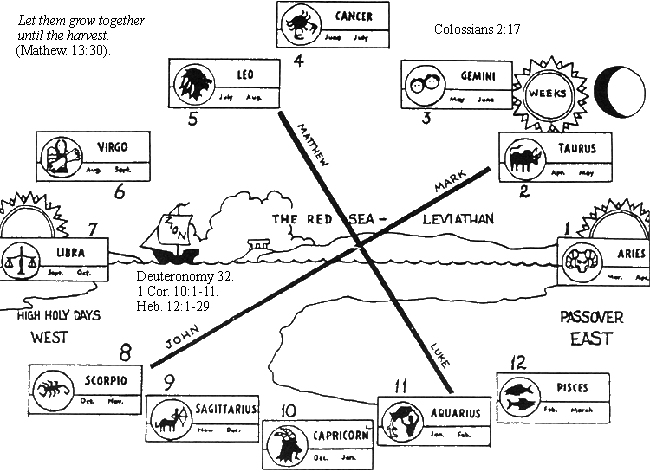
Purge out therefore the old leaven, that ye may be a new lump, as ye are unleavened. For even Christ our Passover is sacrificed for us.
Therefore let us keep the feast, not with old leaven, neither with the leaven of malice and wickedness; but with the unleavened bread of sincerity and truth...(1 Corinthians 5:7,8).
(Bar Tzadok): Yeshu decides to disrupt the Passover holiday. He "made a scourge of cords and drove them all out." (John 2:15). And how is this act of violent social upheaval justified? John 2:17 states, "His disciples remembered that it is written, zeal for your house will consume me...
Will ye steal, murder, and commit adultery, and swear falsely, and burn incense unto Ba'al, and walk after other gods whom ye know not;
And come and stand before me in this house, which is called by My Name, and say, We are delivered to do all these abominations?
Is this house, which is called by My Name, become a den of robbers in your eyes? Behold, even I have seen it, saith the Lord...(Jeremiah 7:9-11).
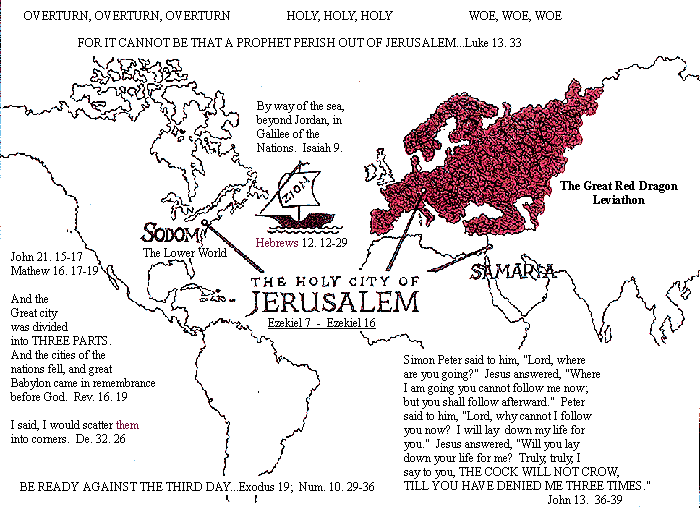
How is the faithful city become a harlot! It was full of judgment; righteousness lodged in it; but now murderers...
Thy princes are rebellious, and companions of thieves: everyone loveth gifts, and follow after rewards: they judge not the fatherless, neither doth the cause of widows come unto them.
Therefore saith the Lord of hosts, the Mighty One of Israel. Ah, I will ease me of mine adversaries, and avenge me of mine enemies...(Isaiah 1:21-24).
In other words, Yeshu was so zealous for the honor of the temple that the mere presence of these cheating moneychangers and animal salesmen was an abomination. The temple is to be a house of prayer and nothing more. These are nice sentiments, but again they portray Yeshu's lack of knowledge of scripture and lack of respect for the temple and its authority.
In Deut.14:22-23, G-g had ordained the law that every male Jew should come to Jerusalem at Passover time to offer "the increase of your seed" and "the tithe of your corn, wine and oil, the first of your herd and flock." In other words, the temple, aside from being simply a house of prayer was a house of sacrifice. This is clearly portrayed in the Bible.
Deut.14:24-26 continues to give the ordinance for the one who does not live near Jerusalem at sacrifice time. How was he to carry all of his fruits and firstborns the long distance to Jerusalem? In Yeshu' day, there were Jews visiting the temple from as far away as Rome and Babylon. Torah law had forseen their long distance trip and ordained, And if the way is too long for you, so that you are not able to carry it...Then you shalt turn it into money, bind up the money in your hand, and go to the place the L-rd, your G-d chooses. And spend the money on whatever you desire: oxen, sheep, wine, strong drink...and you shall eat there before the L-rd, your G-d and rejoice.
Here G-d has ordained that money be brought to his temple and there exchanged for the necessities of eating before the L-rd. Josephus, the Jewish historian, living at the time of the destruction of the temple writes that on an average Passover, there were 250,000 sacrifices offered. Each sacrifice was for a group of ten, therefore, there must have been at least 2 1/2 million people in Jerusalem for an average Passover. Being that the majority of these people were visitors, where were they supposed to purchase their offerings? Being that they came into Israel with foreign currency, where could they go to exchange it into local currency? remember that there were no banks then.
In order to fulfill the Divine commandments to exchange the monies brought from afar, the temple itself, in accordance with Biblical law, not in violation of it, provided for the pilgrims the means to fulfill the Bible's commandments. In other words, the moneychangers and the sellers of doves were themselves fulfilling an important Biblical commandant.
And along came Yeshu.
Bring no more vain oblations, incense is an abomination to me: the new moons, the sabbaths, the calling of assemblies, away with it. It is iniquity, even the solemn meeting...
To what purpose is the multitude of sacrifices to me? saith the Lord. I am full of burnt offerings of rams, and the fat of fed beasts, and I delight not in the blood of bullocks or of lambs, or of he-goats. When ye come to appear before me, who hath required this at your hand?...(Isaiah 1:11-13; 14-17).
__________
Will I eat the flesh of bulls, or drink the blood of goats? Offer unto God thanksgiving and pay thy vows unto the Most High...(Psalm 50:9-14).
__________
Deliver me from bloodguiltiness, O God, thou God of my salvation, and my tongue shall sing aloud of thy righteousness.
O Lord, open thou my lips; and my mouth shall shew forth thy praise.
For thou desirest not sacrifice; else would I give it; thou delightest not in burnt offering.
The sacrifices of God are a broken spirit: a broken and contrite heart , O God, thou wilt not despise.
Do good in thy good pleasure unto Zion: build thou the walls of Jerusalem.
Then shalt thou be pleased with the sacrifices of righteousness, with burnt offering and whole burnt offering: then shall they offer bullocks upon thine altar, (when they are offering themselves)....(Psalm 51:14-19).
__________
"The Qumran Essenes separated themselves from the Jerusalem Temple and its sacrificial cult. The Temple's offerings of animals were replaced by the 'offerings of the lips' (that is, prayers) and by works of the law. Man must render himself to the Lord as a pleasing sacrifice; he must bring his spirit and body, his mental and physical capacities, together with his material goods and property, into the community of God. In this community all of these gifts will be cleansed of the pollution of selfish ambition through humble obedience to the commandments of God. (Manual of Discipline 1:11-13).
The Qumran community was intended to be a living sanctuary. They believed this living temple, consisting of people, rendered a better service to God than the Jerusalem sanctuary made of stones. The chosen "stones" of the community were witnesses to the truth of God and made atonement for the land (Manual of Discipline 8:6-10); in this way, the community protects the land and its people from the consuming wrath of God and the catastrophe of His judgment. The Jerusalem Temple could not do this as long as disobedient priests served in it.
John the Baptist, the son of a priest, also had a conflict with the Jerusalem hierarchy, similar to the conflict between the Essenes and the Jerusalem hierarchy. He must have shared the Essenes' belief in the superior quality of the spiritual temple of God. He warned the people not to rely on the fact that Abraham was their father, for 'God is able from these stones (these precepts of the law) to raise up children to Abraham (That is, a truly repentant community...Matthew 3:9). This famous saying contains a marvelous play on words in Hebrew. 'Children' is banim; stones is abanim. The saying thus presupposes the idea of a living temple 'of men.' John is saying that God can create genuine children of Abraham 'from these stones and build them into the sanctuary of His community." Understanding The Dead Sea Scrolls, by Hershel Shanks, p.211.
__________
Thus saith the Lord, the heaven is my throne, and the earth is my footstool: Where is the house that ye build unto me? and Where is the place of my rest?
For all those things hath mine hand made, and all those things have been, saith the Lord: but to this man will I look, even to him that is poor and of a contrite spirit, and trembleth at my word.
He that killeth an ox is as if he slew a man; he that sacrificeth a lamb, as if he cut off a dog's neck; he that offereth an oblation, as if he offered swine's blood; he that burneth incense, as if he blessed an idol. Yea, they have chosen their own ways, and their soul delighteth in their abominations...(Isaiah 66:1-3).
__________
For I spake not unto your fathers nor commanded them in the day that I brought them out of Egypt, concerning burnt offerings and sacrifices.
But this thing I commanded them, saying obey my voice (and the voice of my prophets), and I will be your God and you will be my people, and walk in all the ways that I have commanded thee that it may be well with thee...(Jeremiah 7:22,23).
__________
But in those sacrifices there is remembrance of sin every year.
For it is not possible that the blood of bulls and goats should take away sin, wherefore when he cometh into the world he saith, Sacrifice and offerings thou wouldst not, but a Body hast thou prepared me:
In burnt offerings and sacrifices for sin thou hast had no pleasure.
Then said I, Lo, I come (in the volume of the book, it is written of me) to do thy will, O God...(Hebrews 10:3-7; Psalm 40:6-10; Psalm 50:7-15).
The Man. Ezekiel 1:5; Acts 13:38,39; Hebrews, chapters 7 to 10 (KJV).
THE FIVE KINDS...This is the law of the BURNT offering, of the MEAT offering, and of the SIN offering, and of the TRESSPASS offering, and of the consecrations and of the sacrifices of the PEACE offerings...(Leviticus 7:37).
__________
And Moses took the blood, and sprinkled it on the people (Seven times), and said, Behold, the blood of the covenant which the Lord hath made with you concerning all these words
Then went up Moses and Aaron, Na'dab abd A-bi'hu, and Seventy of the elders of Israel:
And they saw the God of Israel: and there was under his Feet as it were a paved work of a Saphire Stone (a Sefirot Stone), and as it were the Body of heaven in his clearness...(Exodus 24:8-10).
__________
Without the shedding of blood their is no remission of sin...(Hebrews 9:1-28).
Having boldness, therefore brethren, to enter into the holiest
by the blood of Yeshu, by a new and living way, which he hath consecrated for us, through the veil, that is his flesh...(Hebrews 10:7-29).
__________
And Aaron shall bring the bullock of the sin offering, which is for himself, and shall make an atonement for himself, and for his house, and shall kill the bullock of the Sin offering which is for himself...(Leviticus 16:11-14).
CATTLE. OR OXEN
A symbol of those emotions of the lower nature, which are under control of the higher nature; or of the higher desires...whereas the buddhi-nature is reflected in the desire-nature.
BURNT OFFERING TO THE LORD
A symbol of the offering up of the best of the lower desires (beasts) to the higher ideal, in order that they may be purified by buddhi-fire, and so be transmuted...And every lower emotion and desire given up for the sake of an ideal, becomes the means of this offering of the lower self to the will of the Higher Self in reciprocal action between the two.
"The name given in Scripture to this species of sacrifice is olah, and ascension, so called from the whole being consumed and going up in a flame to the Lord. It also received the name kalil, the whole, with references also to the entire consumption." P. Fairburn, Typology of Scripture, Vol.II, p.344.
"So far as it contained the blood of atonement, even in the course of being presented for the covenant people, it shadowed forth Christ as the one and all for his people. In regard to deliverance from the guilt of sin--the fountain to which they must daily and hourly repair to be washed of their uncleanness." (p.346).
"In the burnt-offering we have seen Jesus as our representative. His (their) offering was offered 'for us,' therefore 'as He is, so are we in this world.' The measure of His acceptance is the measure of our acceptance." A Jukes, The Law of the Offering. p.66.
(Bar Tzadok): Yeshu could not have acted alone in disturbing the entire system of the temple. He must have had the help of his disciples, who were more than just twelve...
For both He (the Angel of Divine Presence) that sanctifieth and they who are sanctified are all of One: for which cause He is not ashamed to call them brethren...(Hebrews 2:9-18; 1 Corinthians 12 and 13. KJV).
Yeshu decides to take matters into his own hands, and again, shows his ignorance of scripture by misquoting a verse from Isaiah: Their burnt offering and their sacrifices will be acceptable on My altar. For My house will be called a house of prayer for all nations. (Is.56:6). This is what Isaiah really said. (What version of the scripture is Bar Tzadok reading)? Of course, G-d wants His sacrifices. After all, He did ordain them. And as for Yeshu's quote about the temple being a house of prayer? Here we see him misquoting this verse.
The words in Isaiah are speaking about messianic times. That is why Isaiah uses the words, For My house will be a house of prayer. However, the emphasis is not that the temple is for prayer,but rather that in messianic days, even the Gentiles will acknowledge G-d's house in Jerusalem and come and pray there. Nowhere is Isaiah making a statement against animal sacrifice as Yeshu implies. On the contrary, Isaiah mentions sacrifice outright. Some-thing that Yeshu "forgot" to mention.
THE TRUE TEMPLE OF GOD
And the feast of the Passover was at hand. And it came to pass that some of the disciples being masons, were set to repair one of the chambers of the Temple. And Yeshu was passing by...
...and they said unto him, Master, see'st thou these great buildings and what manner of stones are here, and how beautiful is the work of our ancestors? And Yeshu said, Yea, it is beautiful and well wrought are the stones, but the time cometh when not one stone shall be left on another, for the enemy shall overthrow both the city and the temple.
And some of the scribes, hearing him, sought to entangle him in his talk and said, if thou wouldst put away the sacrifices of sheep and oxen and birds, to what purpose was this Temple built for God by Solomon which has been FORTY AND SIX years in restoring? (ADaM , 1 + 4 + 1 + 40 = 46). And Yeshu answered and said, It is written in the prophets, My house shall be called a house of Prayer for all nations, for the sacrifice of praise and thanksgiving. But ye have made it a house of slaughter and filled it with abominations.
But the True Temple is the body of man in which God dwelleth by the Spirit, and when this Temple is destroyed, in Three days, God raiseth up a more glorious Temple, which the eye of natural man perceiveth not. Again it is written, FROM THE RISING OF THE SUN UNTO THE SETTING OF THE SAME My Name shall be great among the Gentiles, and incense with a pure offering shall be offered unto me. But ye have made it a desolation with your offerings of blood and have used sweet incense only to cover up the ill savour thereof. I am come not to destroy the law but to fulfill it.
Know ye not what is written? Obedience is better than sacrifice and to hearken better than the fat of rams. I the Lord am weary of your burnt offerings (your sacrifices of your sons and daughters) and vain oblations, your hands are full of blood.
And is it not written, what is the true sacrifice? Wash you and make you clean and put away the evil from before mine eyes, cease to do evil, learn to do well. Do justice for the fatherless and the widow and all that are oppressed. So doing ye shall fulfill (the true meaning of) the law. The day cometh when all that are in the outer court, which pertaineth to blood offerings, shall be taken away and pure worshippers shall worship the Eternal in purity and truth.
And they said, Who art thou that seekest to do away with the sacrifices, and despiseth the seed of Abraham? From the Greeks and the Egyptians hast thou learned this blasphemy? And Yeshu said, Before Abraham was, I am. (Hebrews 5:10-14; 7:1-17). And they refused to listen and some said, he is inspired by a demon, and others said that he is mad; and they went their way and told these things to the priests and elders. The Gospel of the Perfect Life, Lection XLIX.
__________
(Bar Tzadok): Yeshu's act again portray his callousness to the Rabbinic authorities and more so, his blatant disregard for the general community at large who came to Jerusalem to observe the Passover and rejoice. There is no way that a man running around beating people with ropes can be considered anything other than a violent disturbed personality. The disruption of the Passover holiday cannot be considered anything other than an act of terrorism. Whatever happened to "do not resist him who is evil...love your enemies and pray for those who persecute you." (Matt.5:39,44)?
If, in Yeshu's eyes what was happening in the temple was wrong, then following his own advice, he should have prayed to G-d for change rather than act like a violent madman. With regards to his zeal for the temple, zeal has to be properly placed in order for it to be real, Breaking up the Divinely ordained order of providing for the visiting pilgrims is certainly not a proper expression of zeal for the temple. Rather, it is the ultimate expression of insult to the temple.
Are these the deeds of a messiah?
(Let's see now, what are the issues of the temple that we are still dealing with here in the 20th century? Blood sacrifices? Indeed--the blood of sons of daughters who are being offered continually to Molech and the others gods of war. Is God hungry? Politicians, merchants, priests and preachers, teachers and physicians, all of these these are traffiking in the Temple and profaning God-s holy place. What is this place? The heart and mind of the people themselves. All together they have made it a den of thieves and robbers):
If any man defile the temple of God, him shall God destroy; for the temple of God is holy, which temple ye are...(1 Corinthians 3:16,17).
Be ye not unequally yoked with unbelievers: for what fellowship hath righteousness with unrighteousness? and what communion hath light with darkness?...
And what agreement hath the temple of God with idols? for ye are the temple of the Living God: as God hath said, I will dwell in them, and walk in them, and I will be their God, and they shall be my people. (Lev.26:11,12),
Wherefore come out from among them, and be ye separate saith the Lord, and touch not the unclean thing: and I will receive you.
And I will be a Father unto you, and ye shall be my sons and daughters, saith the Lord...(2 Corinthians 6:14-18).
(Bar Tzadok): With regards to Yeshu's warnings about bringing a sword to the earth, at least one of his disciples took his words quite literally. John 18:2-11 portrays the events of Yeshu's arrest. Verse 10 is most revealing: "Simon Peter therefore having a sword, drew it, and struck the high priest's slave, and cut off his right ear."...By trade, Peter was a fisherman, not a soldier, yet he was carrying a sword. Not only did he have a sword; he brandished it rather quickly, and seemed to be quite expert in using it, being that he was able to execute such a precise blow as chopping off an ear before being stopped.
(By religious inclination our brother Bar Tzadok is a literalist. He reads the Torah "literally," and therefore imagines that the Gospels must be interpreted in the same way.
THE ORIGIN AND SOURCES OF THE FOUR GOSPELS
"While we do not know where or by whom the four New Testament gospels were written, scholars realize that they are compilations assembled by what we would today call editors, who drew on various traditions both oral and written, of the early Christian communities. Because of this, the written gospels originate from complex layers of earlier materials from a wide variety of sources. These include collections of 'sayings of the Lord' (like the Gospel of Thomas), collections of miracle stories used by early Christian missionaries, dialogues attributed to Jesus, a passion narrative, miscellaneous legends, and other special sources specific to individual gospels, to name the most obvious. From a historical standpoint, this diversity of sources makes it difficult to paint an accurate portrait of the historical Jesus. While there are undoubtedly some historically reliable teachings and accounts of Jesus in the New Testament, it's impossible to know which ones are and which ones aren't. The fact was recognized long ago by the early church father Origen, who pointed out that some incidents related in the gospels never took place in a 'material' or 'corporeal' sense, but are spiritual allegories meant to be studied as such; as he states quite clearly, 'the careful student may observe countless other instances in the Gospels, and may thus be convinced that with the historical events, literally true, different ones are interwoven which never occurred.'" A Study in New Testament Exegeses.
"This is a noble intention, and it is not my purpose here to articulate a quarrel with the Christian faith, or to call the evangelists liars, or to assert that the Gospels have no historical content. I write as a literary critic, not as debunker. The Gospels are, it must be said with gratitude, works of art, the supreme fiction in our culture, narratives produced by enormously influential literary artists who put their art in the service of a theological vision...But what does it mean to say that the evangelists were literary artists? Literary artists use their imaginations to produce poetry and fiction, works open to literary criticism. The Gospels are, indeed--and to a much greater degree than those who read them with pious inattention even begin to realize--imaginative literature, fiction, and critics have been using such terms about them for a long time. B.H. Streeter, for example, wrote more than a half century ago about the role of 'creative imagination' in the composition of the Fourth Gospel. Reginald Fuller has, more recently, examined the extent to which the Resurrection narratives are the 'free creation' of the evangelists...
As in the case mentioned above, the content of the Gospels is frequently not 'Jesus' but what certain persons in the first century wanted us to think about Jesus. In the language of the Fourth Gospel, These (narratives) here written have been recorded in order that you may hold the faith that Jesus is the Christ, the Son of God. (John 20:31). In the language of literary criticism, the Gospels are self-reflexive; they are not about Jesus so much as they are about their own attitudes concerning Jesus.
That reflexive aspect of the Gospels is one of the main themes of this book. I deal with the effort of the evangelists to present their work to us as self-conscious literary documents, deliberately composed as a culmination of a literary and oral tradition, echoing and recasting that tradition, both appealing to it and transcending it, while using it in multiple ways, The Gospels are Hellenistic religious narratives in the tradition of the Greek Septuagint version of the Old Testament, which constituted the 'Scriptures' to those Greek-speaking Christians who wrote the four canonical Gospelsand who appealed to it, explicitly or implicitly, in nearly every paragraph they wrote." Gospel Fictions, by Randel Helms.
Then Simon Peter having a sword drew it, and smote the high priests servant, and cut off his Right ear. The servant's name was Malchus...(John 17:10).
Then said Jesus unto him, Put up again thy sword unto his place: for all they that take the sword shall perish with the sword.
Thinkest thou that I cannot now pray to my Father, and he shall presently give me more than twelve legions of angels...(Matthew 26:52,53).
Pilate answered, Am I a Jew? Thine own nation and the chief priests have delivered thee unto me: what hast thou done?
Jesus answered, My kingdom is not of this world: if my kingdom were of this world, then would my servants fight, that I should not be delivered to the Jews, but now is my kingdom not from hence...(John 18:35,36).
The Sword of the Spirit, which is the Word of God...(Ephesians 6:10-17, KJV).
Then said he unto them, but now, he that hath a purse let him take it, and likewise his scrip: and he that hath no sword, let him sell his garment and buy one.
For I say unto you, that this that is written must yet be accomplished in me (Isaiah 53), And he was reckoned among the transgressors: for the things concerning me have an end.
And they said, Lord, behold, here are Two Swords. And he said unto them, It is enough...(Luke 22:36-38).
Study to shew thyself approved unto God, a workman that needeth not be ashamed, RIGHTLY DIVIDING THE WORD OF TRUTH...(2 Timothy 2:15).
For the Word of God is quick and powerful, and sharper than any twoedged sword, piercing even to the dividing asunder of soul and spirit, and of the joints and marrow, and is a discerner of the thoughts and the intents of the heart...(Hebrews 4:12).
THE RIGHT EAR? (This just happens to be the Jewish side of the Tree. Let those who HAVE an ear let them hear):
For whosoever hath, to him shall be given, and he shall have more abundance: but whosoever hath not, from him shall be taken away even that he hath.
Therefore speak I to them in parables: because they seeing see not, and hearing hear not, neither do they understand.
And in them is fulfilled the prophecy of Isaiah, which saith, By hearing ye shall hear, and shall not understand; and seeing ye shall see, and not perceive.
For this people's heart is waxed gross, and their ears are dull of hearing, and their eyes they have closed: lest at any time they should see with their eyes, and hear with their ears, and should understand with their heart, and should be converted, and I should heal them...(Matthew 13:10-15; Isaiah 6:9,10).
(Bar Tzadoc): This behavior of Peter should not surprise any knowledgeable Christian. Yeshu was known to have surrounded himself with violent men. Two of his top twelve disciples were known terrorists. There was Simon the Zealot (Matt.10:4, the term for Zealot in Hebrew is 'kenai,' this is sometimes mistranslated as 'cananaean') Then there was the infamous Judas Iscariot. What most do not know is that the name 'Iscariot' was the Greek form of the Aramaic word 'sicarii.' The word sicarii means a short sword or dagger. The term sicarii was not a name, but a title used to describe the worst groups of zealots living during this time. These sicarii zealots were known as 'assassins.' It was they they who instigated the war with Rome and it was they who who eventually caused the destruction of the temple and Jerusalem. In light of Yeshu's statements and acts of violence, I find it no wonder that among his top disciples were members of this most wicked group of misguided 'zealots,'"
I beseech ye therefore, brethren, by the mercies of God, that ye present your bodies a living sacrifice, holy, acceptable unto God, which is your reasonable sacrifice.
AND BE YE NOT CONFORMED TO THIS WORLD: BUT BE YE TRANSFORMED BY THE RENEWING OF YOUR MIND that ye may prove what is that good and acceptable, and perfect, will of God...(Romans 12:1,2).
As ye have therefore received Christ Jesus the Lord (whom Bar Tzadoc calls Yeshu, JEHOSHUA, but whom is not any single individual that ever lived at all), so walk ye in him.
Rooted and built up in him, and established in the faith, as ye have been taught, abounding therein in thanksgiving.
Beware lest any man spoil you through philosophy and vain deceit, after the traditions of men, after the rudiments of the world, and not after Christ...
In whom ye are also circumcised with the circumcision made without hands, in putting off the body of the sins of the flesh by the circumcision of Christ (see Galatians, chapter 5).
Buried with him in baptism, wherein also ye are risen with him through the faith of the operation of God, who hath raised him from the dead...(Colossians 2:1-23).
Howbeit we speak wisdom among them that are perfect; ye not the wisdom of this world, nor of the princes of this world, that come to nought.
But we speak the wisdom of God in a mystery, even the hidden wisdom, which God ordained before the world unto our glory...
But the natural man RECEIVETH not the things of the Spirit of God: for they are foolishness unto him: neither can he know them, because they are spiritually discerned...(1 Corinthians 2:1-16).
(Bar Tzadok): One other point relating to the topic of violence I have found to be of interest. Matt.12:47-50 relates an episode where Yeshu's own mother comes to him and asks to see him. And someone said to him, Behold your mother and your brothers are standing outside seeking to speak to you. But he answered the one who was telling him and said, Who is my mother and who are my brothers? And stretching out his hand toward his disciples, he said, Behold my mother and my brethren. For whosoever shall do the will of my Father who is in Heaven, the same is my brother and sister and mother.
Rather than fulfill the Biblical edict to honor one's parents, Yeshu chooses to ignore his own mother. Not only is this type of response inappropriate and disrespectful, it is all too familiar today to those who have lost loved ones to the growing number of religious cults in the world. Cults today teach members to cut off all outside connections with loved ones, who because they are not members of the cult they are no longer to be considered as family. The detestable twisting of the mind seems not to be anything new. Even Yeshu thought this way with regards to his own family. While this is not physical violence, it is most certainly emotional abuse.
Again, I ask you are these the deeds of a messiah?
Jesus said, Whoever does not hate his father (one's old natural ways) and his mother (one's former way of perceiving reality) cannot become my disciple. And whoever does not hate his brothers and sisters (the ways of the Right and the ways of the Left) and take up his cross in my way will not be worthy of me...(Gospel of Thomas 55).
Jesus said, Whoever does not hate his father and his mother as I do cannot be a disciple to me. And whoever does not love his father and his mother as I do cannot become a disciple to me. For my mother (is my old nature) but my true mother gave me life...(Gospel of Thomas 101).
__________
Now there stood by the cross of Jesus his mother, and his mother's sister, Mary the wife of Cleophas, and Mary Magdalene, (all literary figures in the great epic drama of redemption).
When Jesus therefore saw his mother, and the disciple standing by, whom he loved, he saith unto his mother, Woman, behold thy son!
Then saith he to the disciple, Behold thy mother! and from that hour that disciple took her into his own home...(John 19:25-27).
There were Three who always walked with the Lord: Mary his mother and her sister and Magdalene, the one who was called his companion. His sister and his mother and his companion were each a Mary...(Gospel of Philip 59:5-10).
Jesus said to him, You do not realize who I am from what I say to you, but you have become like the Jews, for they either love the Tree and hate its fruit, or love the fruit and hate the Tree.
Jesus said, Whoever blasphemes against the father will be forgiven, and whoever blasphemes against the son will be forgiven, but whoever blasphemes against the Holy Spirit (the Divine Mother, Holy Wisdom Herself who is the author of these sacred text) will not be forgiven either on earth or in heaven...(Gospel of Thomas 43,44).
YESHU AND PROPHECY
Christianity has portrayed Yeshu as being a great prophet, even greater than Moses. Yet, prophecy is an exact science. Just because someone offers a prophecy does not make that one a prophet. There are rules to prophecy that are outlined in the Bible. This was necessary, for just as there is true prophecy, there also exists false prophecy. With regards to telling the difference between true and false prophecy, it is written in Deut.18:21-22:
When you say in your heart, 'How can we know the word that G-d has not spoken?' If the prophet will speak in the Name of G-d and that thing will not occur and not come about--that is the word that G-d has not spoken; with willfulness has the prophet spoken it, you should not fear him...
Bar Tzadok goes on to cite the fact of Israel's return to its own land, the inevitable victory of the Jewish people over their Arab foes (because of God's certain favor for His Jewish people) and the eventual reconstruction of the Temple in Jerusalem (and the return of animal sacrifices), as blaring examples of the failure of Yeshu's words and the resulting collapse of the Christian world-view. We will offer the whole of this Commentary on the Tree of Life, and the reality of those things that are unfolding in the earth at this present time, as proof-positive of the life and prophetic powers of that one who Bar Tzadoc calls Yeshu. And we will conclude this chapter with a blessing on all the children of Israel, Jew and Gentile alike:
I say then, Hath God cast away His people? God forbid. For I am also an Israelite, of the seed of Abraham, or the tribe of Benjamin.
God hath not cast away His people which he foreknew. Wot ye not what the scripture saith of Elijah? how he maketh intercession to God against Israel, saying,
Lord, they have killed thy prophets, and digged down thy altars; and I am left alone, and they seek my life. (1 Kings 19:10-18).
But what saith the answer of God unto him? I have reserved to myself Seven thousand men, who have not bowed the knee to the image of Ba'al.
Even so at this present time also there is a remnant according to the election of grace...
I say then, Have they stumbled that they should fall? God forbid: but rather through their fall salvation is come unto the Gentiles, for to provoke them to jealousy.
Now if the fall of them be the riches of the world, and the diminishing of them the riches of the Gentiles; how much more their fulness?...
For if the casting away of them be the reconciling of the world, what shall the receiving of them be, but life from the dead? (Understand 1 Corinthians 15:29,30 and Ezekiel 37).
For if the firstfruit be holy, the lump also is holy: and if the root be holy, so are the branches.
And if some of the branches be broken off, and thou, being a wild olive tree, were graffed in among them, and with them partakest of the root and fatness of the olive tree;
Boast not against the branches. But if thou boast, thou bearest not the root, but the root thee.
Thou wilt say then, The branches were broken off, that I might be graffed in.
Well: because of unbelief they were broken off, and thou standest by faith (not by knowledge). Be not highminded, but fear:
For if God spared not the natural branches, take heed lest He also not spare thee...
And they also, if they abide not still in unbelief, shall be graffed in: for God is able to graff them in again...(see Isaiah 4:1,2)...
For I would not, brethren, that ye should be ignorant of this mystery, lest ye should be wise in your own conceits; that blindness in part is happened to Israel, until the fulness of the gentiles be come in.
And so all Israel shall be saved: as it is written, There shall come out of Zion the Deliverer, and shall turn away ungodliness from Jacob, (see Isaiah 59:20,21; Isa. 27:6-9):
For this is My covenant unto them, when I shall take away their sins.
As concerning the gospel, they (have been) enemies for your sakes: but as touching the election, they are beloved for the Fathers' sake...(Romans 11:1-36).